From Form-Finding to Load Zones
Snow Load Assessment on Freeform Membrane Roofs with RFEM, Rhino and Grasshopper
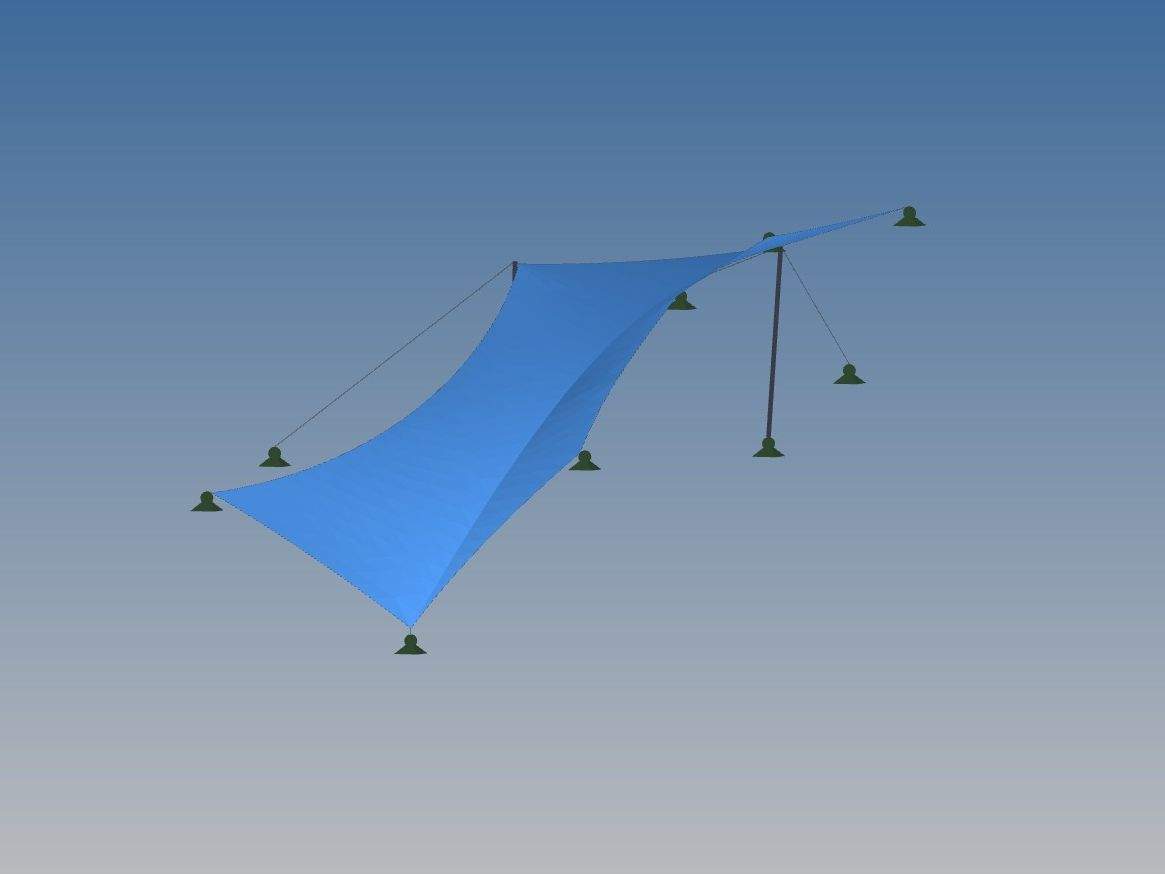
During the form-finding and structural analysis of a recent textile canopy, the overall impression was that the roof geometry was steep enough for snow to slide off, and that a full-surface snow load might therefore not be necessary. In exactly this kind of situation, however, it is worth looking beyond intuition and testing the geometry more closely.
With freeform membrane roofs, the snow-load question is rarely as clear as the first visual impression suggests. Some areas may indeed be very steep and promote sliding, while adjacent zones may be significantly flatter and still require snow loading. A global impression of the surface is therefore not enough. Under EN 1991-1-3, the snow load shape coefficient for pitched roofs decreases as roof inclination increases and reaches zero at 60°, provided snow is not prevented from sliding off the roof; where parapets, snow guards, or other obstructions exist, the reduction cannot be applied in the same way.
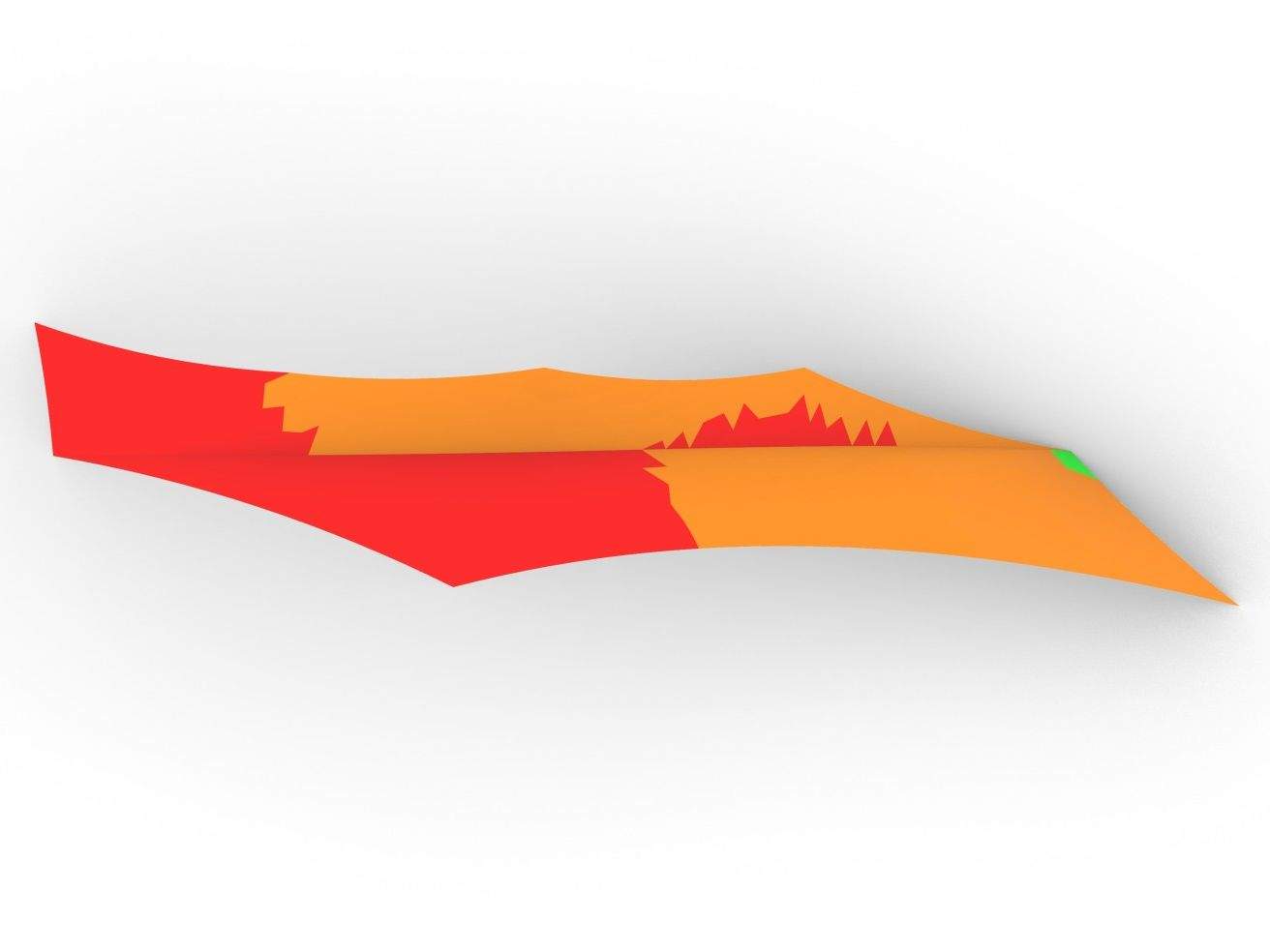
This is where a local geometric analysis becomes useful. Instead of treating the membrane as one roof with one pitch, the surface can be evaluated face by face. The result is a zoning map that shows which parts of the roof are shallow, moderately inclined, or steep enough to justify a differentiated assessment of snow loading.
Starting point: form-finding in RFEM, geometry analysis in Rhino
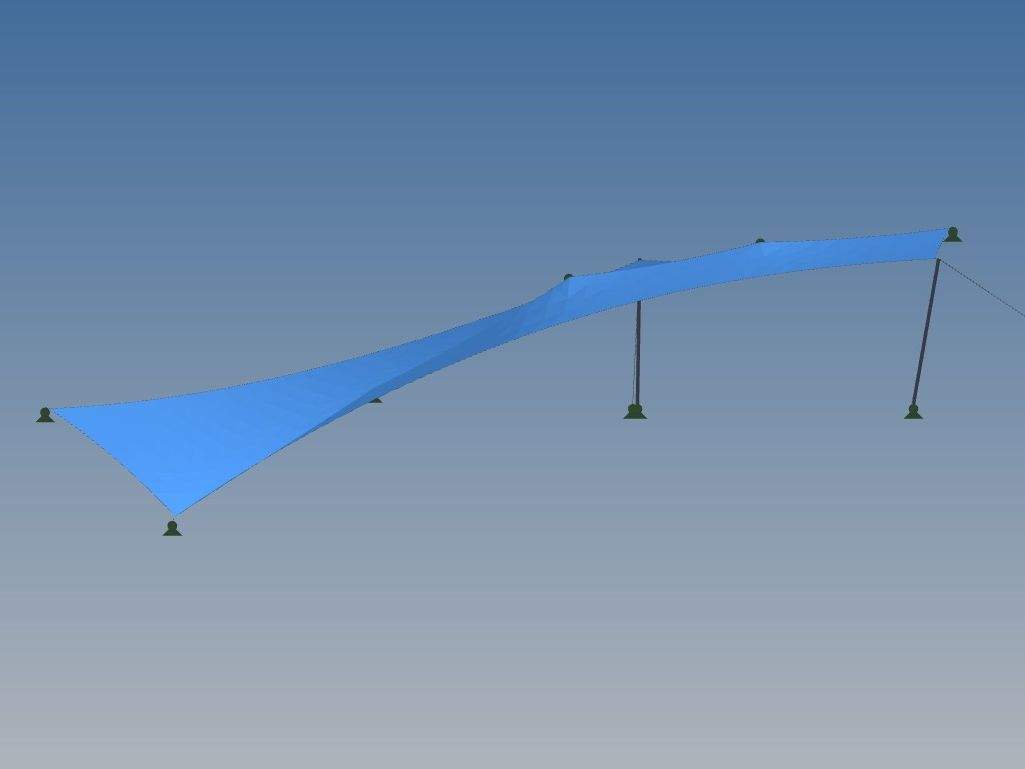
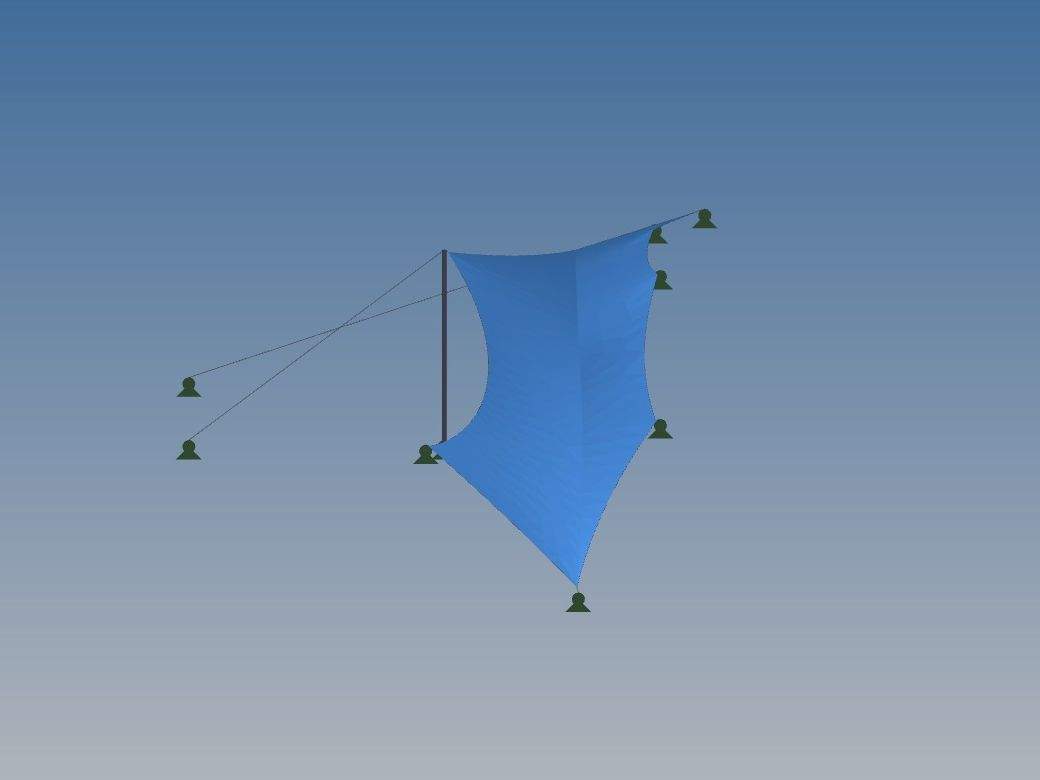
In this case, the membrane shape was generated in RFEM 5 using RF-Form-Finding. For the geometric evaluation, the shape was exported as a DXF and further processed in Rhinoceros 3D and Grasshopper 3D. The roof did not exist as one analytically clean surface, but as a triangulated polygon mesh made up of many individual faces, each with its own local plane.
That is typical for form-found membrane geometries. There is no single roof pitch that meaningfully describes the whole surface. Instead, the inclination has to be assessed locally, face by face. Only then does it become possible to decide, in a transparent way, which areas remain relevant for snow loading and which areas may be considered for reduction.
The code background: the 60° threshold is only the beginning
At first glance, the code logic seems straightforward. For pitched roofs, EN 1991-1-3 reduces the snow load shape coefficient as the pitch increases: up to 30° it remains unchanged, between 30° and 60° it is reduced linearly, and at 60° it reaches zero for this load case. The same provision also makes clear that this applies only where snow can slide off freely. If sliding is hindered by roof details or edge conditions, the reduction is limited. The code also requires separate consideration of drift, accumulation and lower roof areas for more complex roof geometries.
For projects in Switzerland, the site-specific characteristic snow load is determined under SIA 261:2020-08. In that context, the local inclination study is not a replacement for the code-based load definition; it is a complementary geometric tool that helps subdivide a freeform roof into zones that are plausibly loaded, potentially reduced, or in need of closer review.
This distinction matters. A locally steep area may indeed promote sliding, but the snow does not disappear; it may be transferred into flatter adjacent zones, depressions, or lower areas. The inclination analysis therefore does not replace engineering judgement on sliding paths, collection zones, or local accumulation. What it does provide is a much stronger geometric basis for that judgement.
Why Grasshopper is useful here
RFEM is the tool for form-finding and structural analysis. Grasshopper, by contrast, is extremely effective for making the geometry readable. Working directly on the mesh makes it possible to evaluate every triangular face individually, classify it by inclination, and display the result as a zoning map.
In that sense, Grasshopper is not a substitute for the FEM model. It becomes an intermediate analysis layer between geometry and load definition. That is especially valuable for freeform roofs, where complex surfaces often need to be translated into simple, understandable engineering decisions.
A native Grasshopper workflow
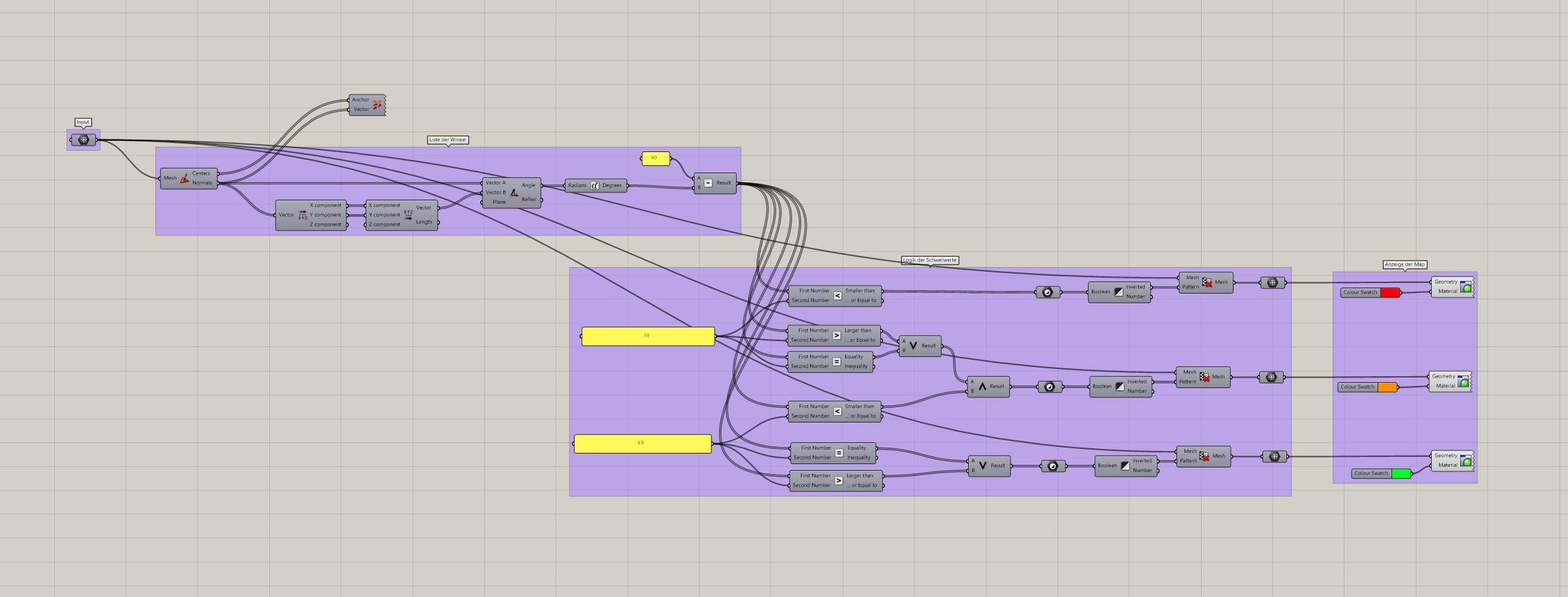
The workflow can be built with native Grasshopper components.
The exported mesh is used as the starting point. For each face, the local face normal is determined. From that normal, the angle to the horizontal plane can be calculated. This gives the relevant local roof inclination for every triangle in the mesh.
The faces can then be classified into three ranges:
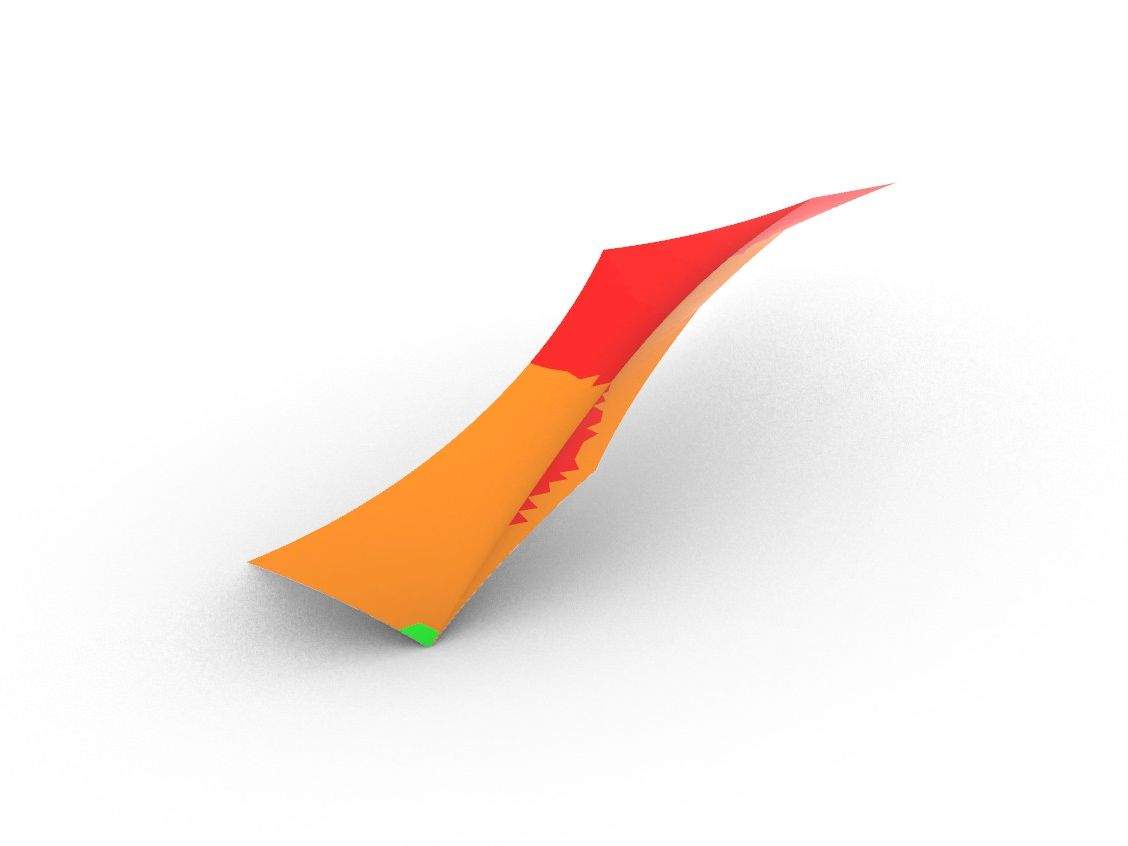
Zone 1 – red: inclination below 30°
Zone 2 – orange: inclination from 30° to below 60°
Zone 3 – green: inclination of 60° and above
This three-part classification follows the code logic directly. Up to 30°, the snow action remains fully relevant. Between 30° and 60°, the reduction begins. At 60° and above, the snow load for this load case can in principle be neglected, provided that sliding is not prevented.
Instead of stopping at a numerical list of angles, the mesh is then visualized as a colored zoning map. That map is more than a graphic. It is a working tool. It shows immediately where snow loading still has to be applied, where reduced assumptions may be justified, and which zones deserve additional scrutiny.
From freeform geometry to engineering judgement
The real value lies not only in calculating angles, but in making the shape interpretable. A zoning map turns a freeform membrane into something that can be read. Low-inclination areas remain clearly visible as snow-relevant zones. Transition areas can be identified. Steep zones can be isolated and reviewed more critically.
At the same time, the map also reveals where a purely local angle check is not enough. This applies, for example, to valleys, transitions, and areas below steeper parts of the roof, where local accumulation may still occur. For complex roof geometries, this remains an essential part of the engineering assessment under the snow-load rules.
Feeding the result back into the structural model
The geometric analysis can then be translated back into the RFEM model. Instead of applying snow uniformly over the entire membrane, load zones can be defined where they are geometrically meaningful and code-plausible.
This does not only improve the quality of the structural model. It also improves transparency. The assumptions become easier to explain to project partners, reviewers, and clients because they are no longer based on a general impression of the roof, but on an explicit geometric evaluation.
Practical note: assess both the initial and the deformed shape
One additional point is particularly important in membrane design. The first zoning map is based on the initial form-found geometry. For an initial assessment, that is entirely reasonable. But membrane structures are analyzed with large deformations, and this means that the geometry under snow load may change enough to alter the local inclination pattern.
For that reason, it can be very useful to export not only the initial mesh, but also the deformed mesh under snow loading, and to evaluate it again. This second check can reveal newly flattened areas, emerging collection zones, or other unfavorable regions where a reduction of snow load may no longer be justified.
In that sense, the zoning map becomes a two-stage analysis tool: first for the initial shape, then for the loaded and deformed shape. Especially in softer or more deformation-sensitive membrane structures, that second step can make the load assumptions more robust and more defensible.
Value for the structural report
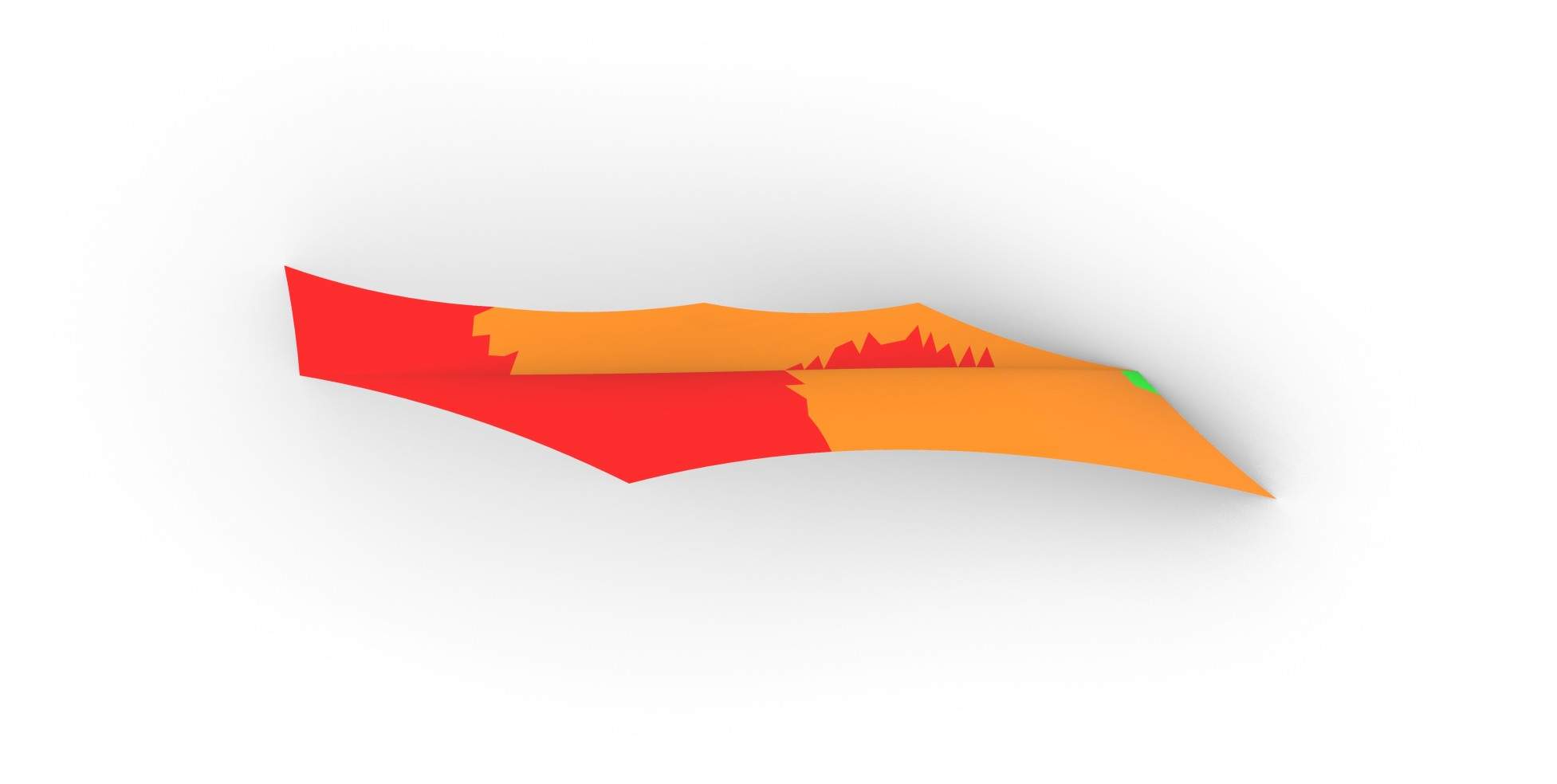
The method also has clear value for documentation. In the structural report, a zoning map can make the derivation of snow-load zones far more transparent. It links the freeform geometry directly to the load assumptions and helps explain why certain areas were fully loaded, reduced, or subjected to further review.
For textile structures and other non-standard roof forms, this is often crucial. The decision is no longer presented as a blanket statement, but as a geometry-based assessment that can be followed visually and logically.
Outlook
The approach is not limited to snow loads. A face-based evaluation of freeform meshes can also support studies of drainage behavior, collection zones, deposition tendencies, or other geometry-related load questions.
That makes Grasshopper a useful bridge between form-generated geometry, engineering interpretation, and well-documented structural design.
Conclusion
Freeform membrane roofs require a different kind of geometric readability than conventional roofs. RFEM generates and evaluates the structural shape, but Grasshopper can help translate that shape into locally understandable load zones.
Evaluating face inclinations and visualizing them as a zoning map is a simple but powerful step. It connects code logic, geometry, and structural modeling in a transparent way, and turns a complex freeform surface into a defensible basis for snow-load assessment.
If you want, I’ll turn this next into a polished website-ready version with a shorter intro, tighter subheads, and a more editorial tone for your blog.