From Proportion to Equilibrium
On Geometry, Form Finding and the Architectural Integration of Textile Structures
Textile architecture is often praised for its lightness, efficiency and expressive potential. Yet it still remains difficult to integrate into everyday architecture. I believe this difficulty is not only technical. It is also geometric, cultural and perceptual.
Most conventional architecture relies on clear lines, stable contours, orthogonal grids and recognisable orders. Textile architecture follows a different logic. Its forms do not primarily emerge from composition, proportion or formal intention, but from curvature, tension, material behaviour and equilibrium. This is precisely where its strength lies and also where its unfamiliarity begins.
My own understanding of geometry did not begin with membranes. It began with proportion.
Early Orders
Geometry has always held a particular fascination for me. From an early stage, I was drawn to the idea that numbers, proportions and orders might reveal something fundamental about design. The golden ratio played an important role in this early interest. I was particularly inspired by Le Corbusier’s Modulor. Even though his architecture never felt especially close to me on a personal level, I was moved by the idea of using human proportions as a basis for humane architecture. It was an attempt to bind design to a larger order rather than leaving it to arbitrary decisions.
During my early years as a designer, proportion became an important tool. It was never merely an aesthetic game, but a way of relating measure, tension and calm. This way of thinking still matters to me.
The Fibonacci sequence also fascinated me, although it remained more distant. I experimented with it, but it never became a guiding principle in the same way. Prime numbers interested me as well, perhaps precisely because of their singularity and apparent resistance to easy interpretation. Yet they, too, remained at the margins of my design thinking.
Still, I always had the feeling that both Fibonacci numbers and prime numbers deserved more attention than I was able to give them. Perhaps there was already an early intuition in this: mathematical order is far more diverse than any single design principle can capture.
The Discovery of Process-Based Geometry
Another important encounter was with Benoît B. Mandelbrot. His ideas on fractal geometry opened up a new way of seeing form and nature. The Koch curve, in particular, stayed with me. Later, when I began working with Python, I encountered it again. Suddenly, it was no longer only a theoretical object. It became something that could be generated through rules, iteration and code.
This experience was formative because it showed me that geometry does not only describe form. It can also produce form.
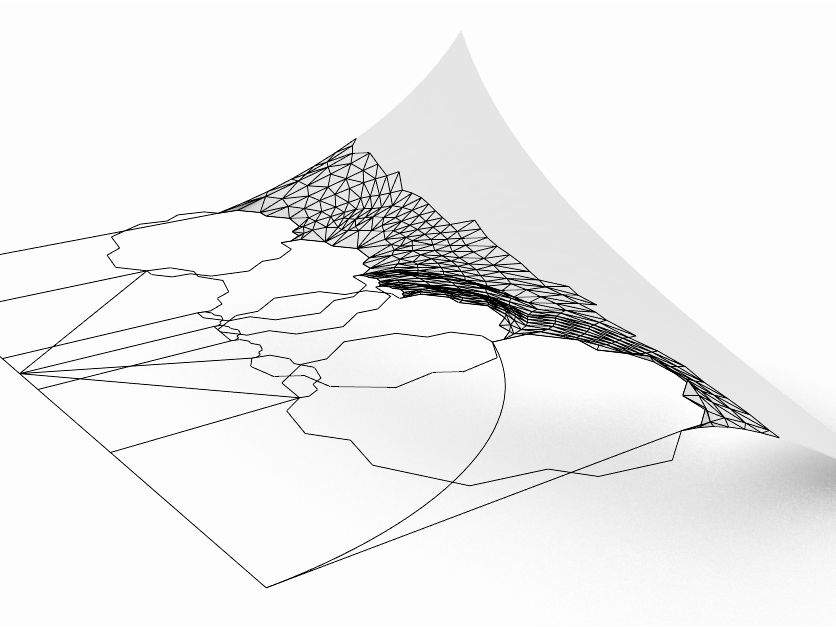
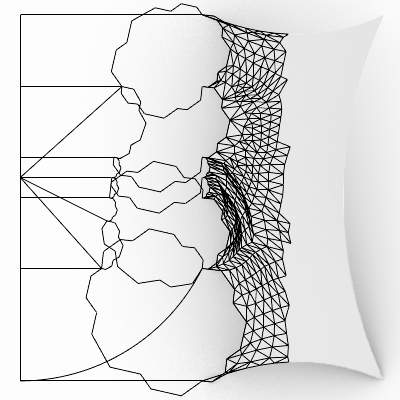
What fascinated me most was not only the act of iteration itself, but the idea that a line can become more than a line. In fractal geometry, a line begins to take on qualities of a surface. It remains a boundary, but at the same time becomes denser, richer, almost spatial.
This transition stayed with me. After all, the line is ultimately a human invention: a means of ordering, separating and interpreting the world. In nature, there are no lines in the strict sense. What we perceive or draw as a line is usually the contour of something an abstraction of a transition.
This also reveals a difference between technical and organic perception. A continuous line appears determined, hard and unambiguous. Softness then has to be produced mainly through curvature. In drawings of nature, vegetation or materiality, something else often happens: contours are loosened, interrupted or merely suggested. They lose their rigidity and begin to appear softer, richer and more organic.
This is where fractal geometry touched me so deeply. It gave mathematical precision to a threshold condition: the idea that a line can point beyond itself and begin to assume something of the nature of a surface.
From there, a further question emerged. Fractals are not only interesting because they can be recognised in nature or in visual patterns. More interesting is the reversal of perspective: what happens when fractal logic is understood not only as an analytical tool, but as a way of deliberately generating form?
Geometry then ceases to be merely a means of description. It becomes a tool of formation. A new understanding of form begins to appear: form not simply as a drawn contour, but as the result of a process, a rule, an internal logic.
The Revelation of Textile Architecture
The real revelation, however, came with textile architecture. Through it, minimal surfaces and later equilibrium surfaces entered my thinking. Frei Otto and the form finding experiments with soap films showed that geometry can be understood not only as order or pattern, but also as the result of a physical balance.
Form was no longer something that was simply imposed. It was something that emerged under boundary conditions.
When I began to engage more deeply with textile architecture, I had to realise that my previous understanding of geometry had only been a beginning. I had thought that I already had a good relationship with geometry. But during my studies, I experienced a steep learning curve, particularly through my engagement with differential geometry.
Looking back, this was the key. Only then did it become possible to understand three-dimensional geometry not only visually, but also in terms of its application and programming. And only then did the decisive transition become clear to me: the transition from a calculated FEM model to the buildable, constructed reality of a textile roof.
In textile architecture, geometry cannot remain abstract. A calculated equilibrium surface is not yet a building. Only through an understanding of curvature, material direction, patterning, cutting, fabrication and assembly does a mathematical surface become a real roof. In this transition, mathematics, construction, material and fabrication are directly connected.
At the same time, it became increasingly clear to me how difficult it is to connect the golden ratio, the Fibonacci sequence, prime numbers, the Koch curve and textile form finding. At first glance, all these principles appear to have something to do with nature. They frequently appear in discussions about order, growth, beauty and self-organisation. But the closer one looks, the clearer it becomes that they describe very different kinds of order.
The golden ratio is a principle of proportion.
Fibonacci describes recursion and approximation.
Prime numbers belong to the world of discrete structure.
The Koch curve stands for iteration and self-similarity.
Minimal and equilibrium surfaces, however, do not describe proportional or recursive order. They describe a physical order. They emerge from forces, tensions and boundary conditions.
This is why these principles cannot simply be harmonised. They do not speak of the same nature. They may all claim to reveal something natural, but they do so on different levels.
The golden ratio orders.
Fibonacci sequences.
Prime numbers structure.
Fractals scale.
The membrane seeks equilibrium.
Between Unfamiliarity and Future
From this unresolved diversity of orders, another observation emerges. It is not only theoretical, but directly concerns the position of textile architecture today.
For me, this difference in internal logic is one of the main reasons why textile architecture still struggles to become part of contemporary everyday architecture. The formal language of ordinary building is usually shaped by clear horizontals and verticals. Roofs are expected to be flat, buildings ordered, precise and self-evidently embedded within the grid of a largely cubic architectural world.
Textile architecture follows another order. Its forms do not primarily arise from orthogonal composition, but from curvature, tension, equilibrium and material behaviour. This is its strength and at the same time the source of its unfamiliarity.
Where textile structures stand on their own, this formal language can be highly convincing. They appear independent, light and internally coherent. Within the context of conventional architecture, however, they can quickly seem like something from another world. This becomes particularly evident in everyday buildings, rather than in the few large reference projects. There, the integration of textile elements into existing or newly planned architecture requires a great deal of sensitivity.
This unfamiliarity also has to do with our architectural way of seeing. Everyday architecture trusts the closed line. Horizontals and verticals define the contour: precise, hard and clear. In nature, such lines do not exist. Edges appear as transitions, gradations and densities.
In drawing and art, the organic is therefore rarely captured through sharply closed contours. It is more often suggested through loosened, broken or implied lines. Here again, fractal geometry becomes relevant to me. It shows that a line can be more than a boundary. It can become denser, richer, almost surface-like.
Perhaps this is one reason why textile architecture often appears more at ease in landscape settings than within a strictly orthogonal built environment.
In landscape architecture, the situation is different. Textile architecture seems more readily integrated there, especially when it is considered early in the design process. In a landscape context, its lightness, openness and force-derived form are more easily understood as enrichment. The textile structure has less need to defend itself against a rigid orthogonal order and can act more freely from within its own logic.
Insight and Task
This leads to what I see as the real future task. If the advantages of textile architecture, its performance, its lightness and its ecological value as a material-efficient way of building, are to become more widely usable, it is not enough to merely insert textile architecture into existing architectural modes of thought.
Architecture itself must become more open to other geometric and constructive logics. At the same time, classical textile architecture must also continue to evolve if it is to find new forms of integration.
For me, this is no longer a deficiency, but an insight. I do not need to reduce all these principles to a single formula. Perhaps their true connection lies precisely in the fact that they open up different ways of understanding the world.
My early engagement with proportion sharpened my sense of measure and relation. Fibonacci and prime numbers awakened my sensitivity to hidden orders. Fractal geometry showed me that rules can generate complex forms. And textile architecture taught me that form is not only conceived, but found.
I now see my path as a movement from proportion to equilibrium. Not as a rejection of earlier thinking, but as its extension. My early interest in proportion has lost none of its meaning. But through textile architecture, my understanding of geometry has fundamentally deepened. Geometry is no longer only a means of composition. It has become a medium of understanding, between nature, mathematics, material and built reality.
Perhaps the real task begins here: not only to understand textile architecture better, but to imagine an architecture in which its logic no longer appears as a foreign body.
Outlook: Coupled Equilibria
This task leads one step further. The membrane is not the end of this development. It shows that form can emerge from forces, tensions and boundary conditions. This immediately raises the next question: what happens when this logic does not remain isolated, but is connected with other lightweight structural systems?
Membranes are not determined only by their boundaries. Elements can also be introduced within the surface to influence the process of form finding: arches, high points, masts, local supports or grid-like structures. Such interventions alter the freely spanning character of the membrane. At the same time, they make new forms possible, redistribute forces and reduce the dependence on massive boundary conditions.
In this context, the gridshell becomes particularly interesting. It contains an internal grid and therefore an order that is more familiar to everyday architecture than the freely tensioned membrane surface. This grid can become a link between force-derived curvature and a built world shaped by axes, fields, repetition and connections.
The work of Shigeru Ban is inspiring in this respect. His gridshells show that spatial grids are not merely load-bearing structures. They can also create architectural envelopes, lightweight roofs and atmospheric spaces. The most compelling moments occur where such gridshells are combined with membranes. There, two different principles meet: the tensioned membrane and the supporting, shell-like grid structure.
This encounter points towards an important future question. Membranes and gridshells do not have to be designed one after the other. They can be conceived and form-found together. Not first one structure and then the other, but a hybrid system in which both develop their form through a coupled equilibrium.
Such an architecture is more than a constructive combination. It brings tension and compression, spanning and supporting, textile envelope and spatial grid into a shared relationship. This is one of the essential possibilities for the further development of textile architecture: not by abandoning its own logic, but by connecting it with other constructive orders.
The movement from proportion to equilibrium therefore does not end with the equilibrium of a single membrane. It extends towards the coupled equilibrium of multiple systems. In this coupling lies a decisive future space for textile architecture.
Textile architecture should not remain a special case at the margins of building culture. It can become a starting point for a lighter, more intelligent and more adaptable architecture, an architecture that does not accumulate material, but activates it; that does not force form, but develops it from forces; and that offers a contemporary response to the architectural questions of the future.
When Lines Become Form
On Geometry, Form Finding and Textile Architecture