When Good Details Become Even Lighter
Investigating and Optimising Corner Details of a Temporary Textile Canopy
As part of the renewal of an existing textile canopy on the village square of Geroldswil, not only the overall structure but also several individual corner details were reconsidered. This article focuses on the investigation and redesign of four corner connections and shows how reverse engineering, closer structural analysis, and a more precise understanding of actual behaviour made it possible to simplify highly sophisticated details — with clear benefits for design, fabrication, installation, and recurring assembly.
Geroldswil as a Point of Departure
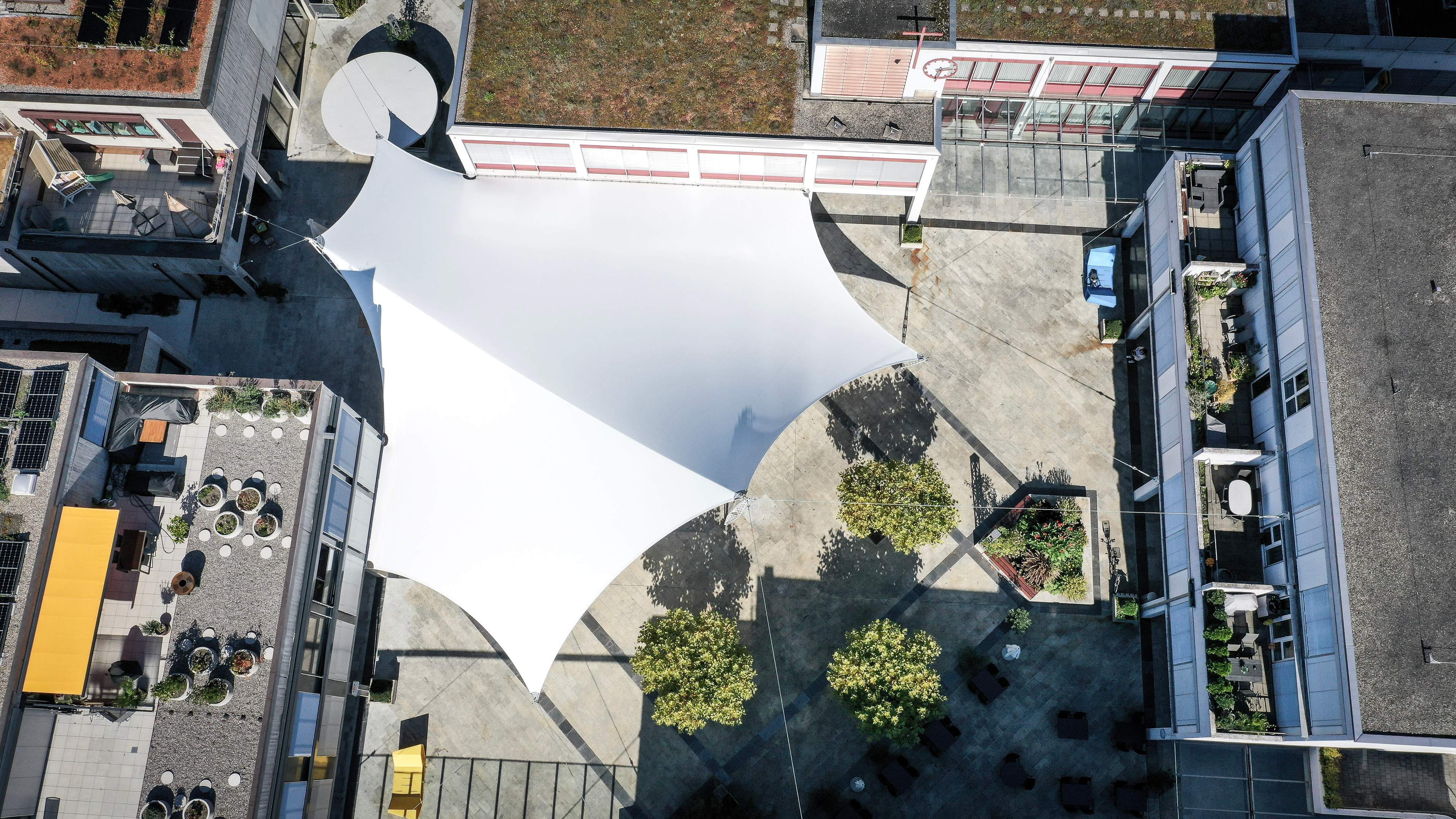
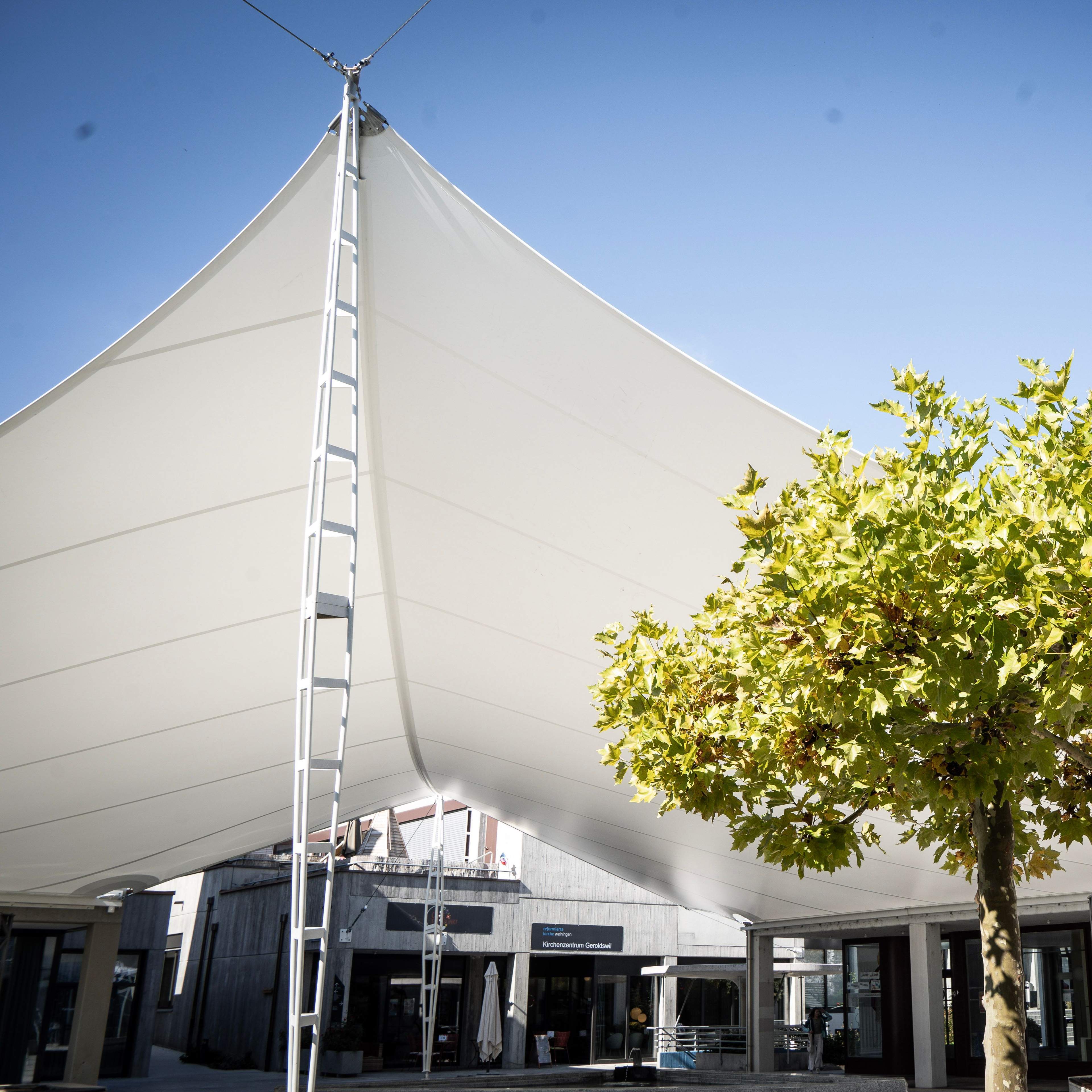
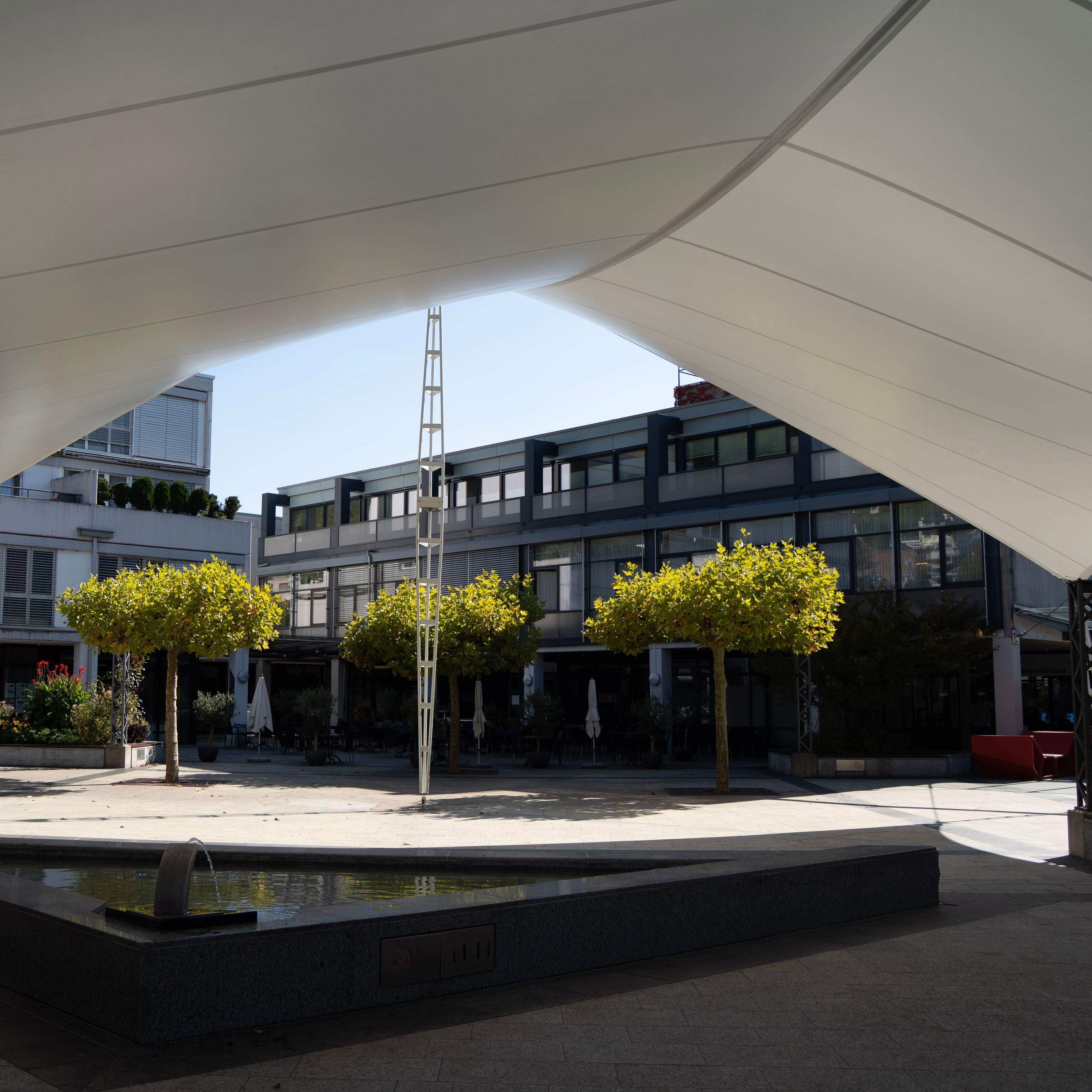
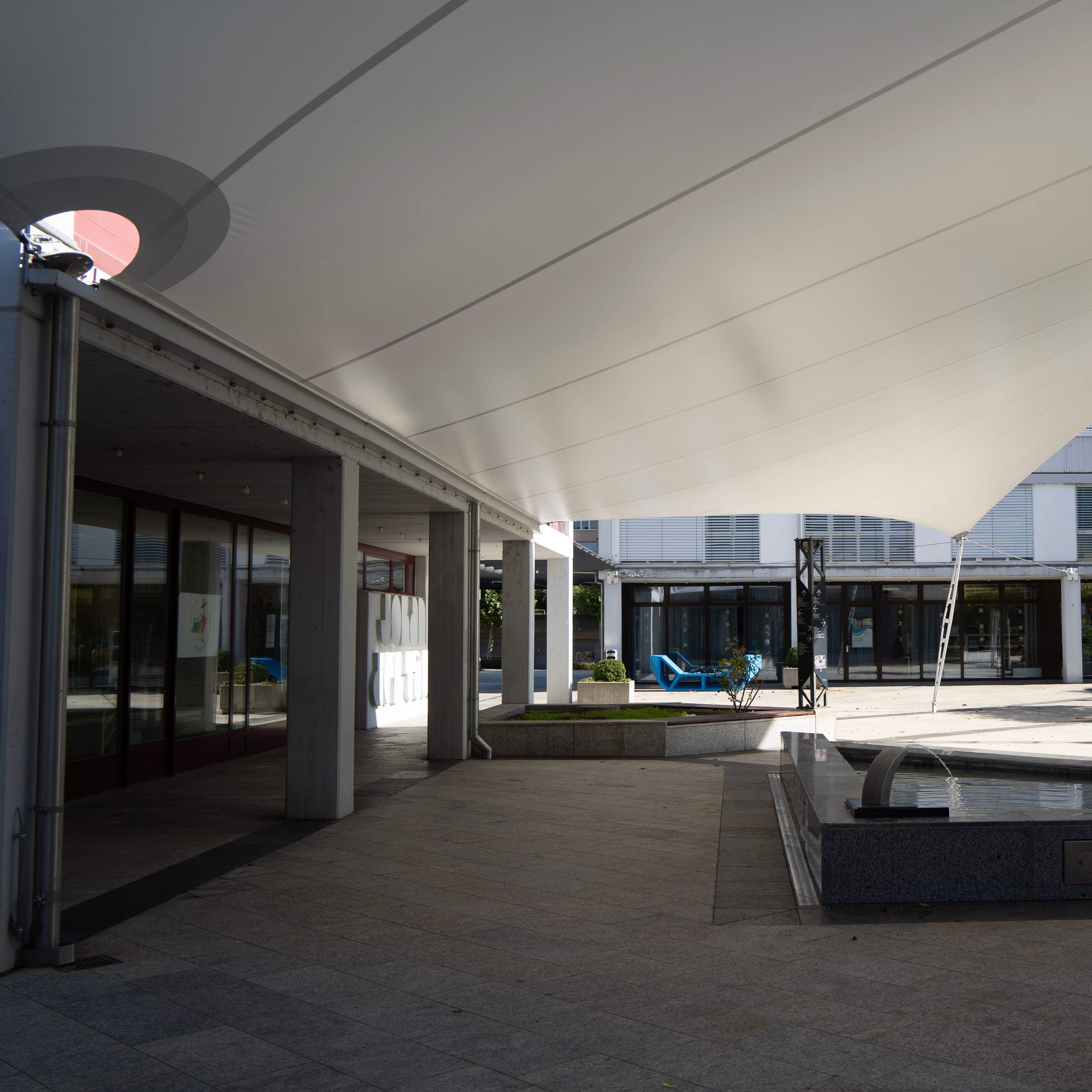
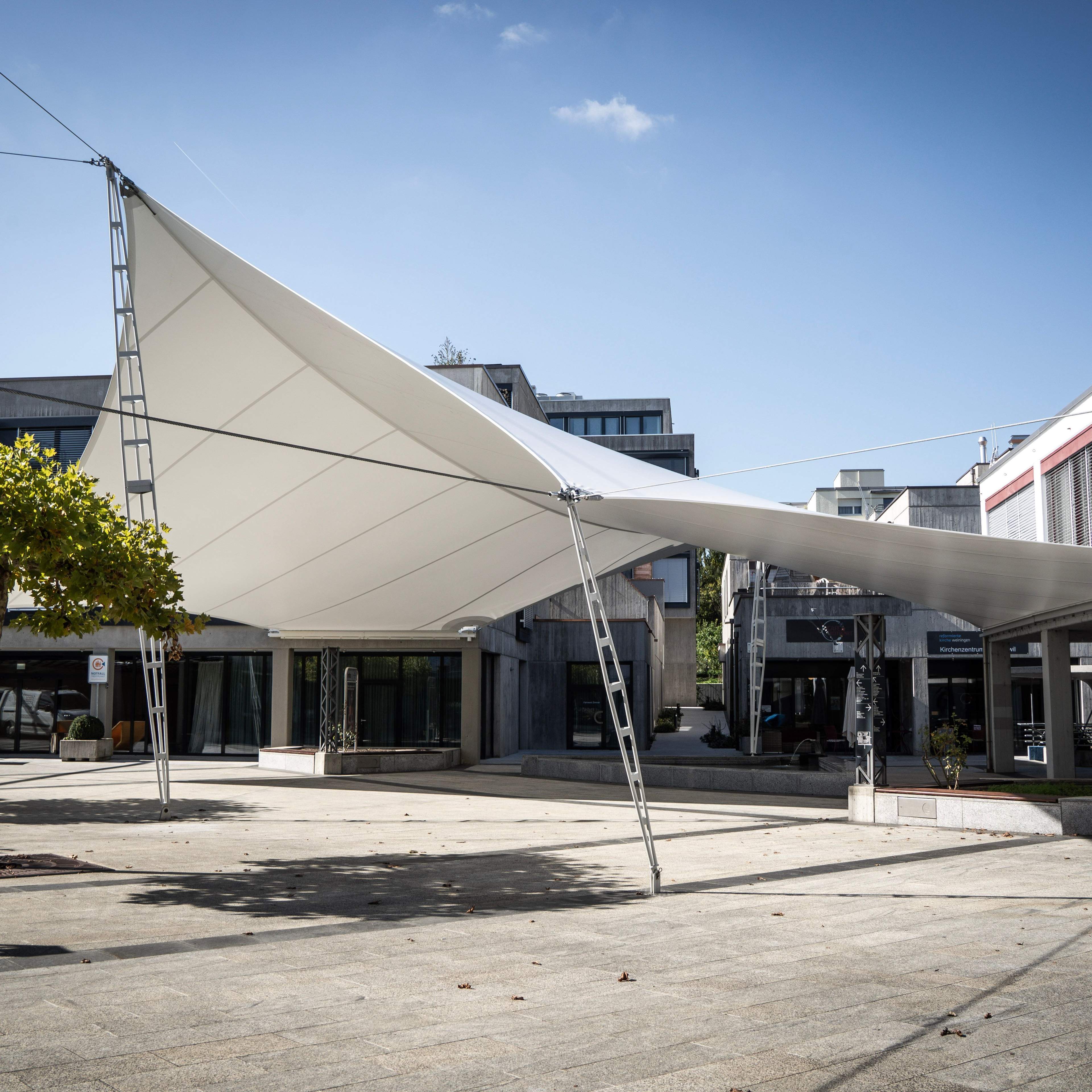
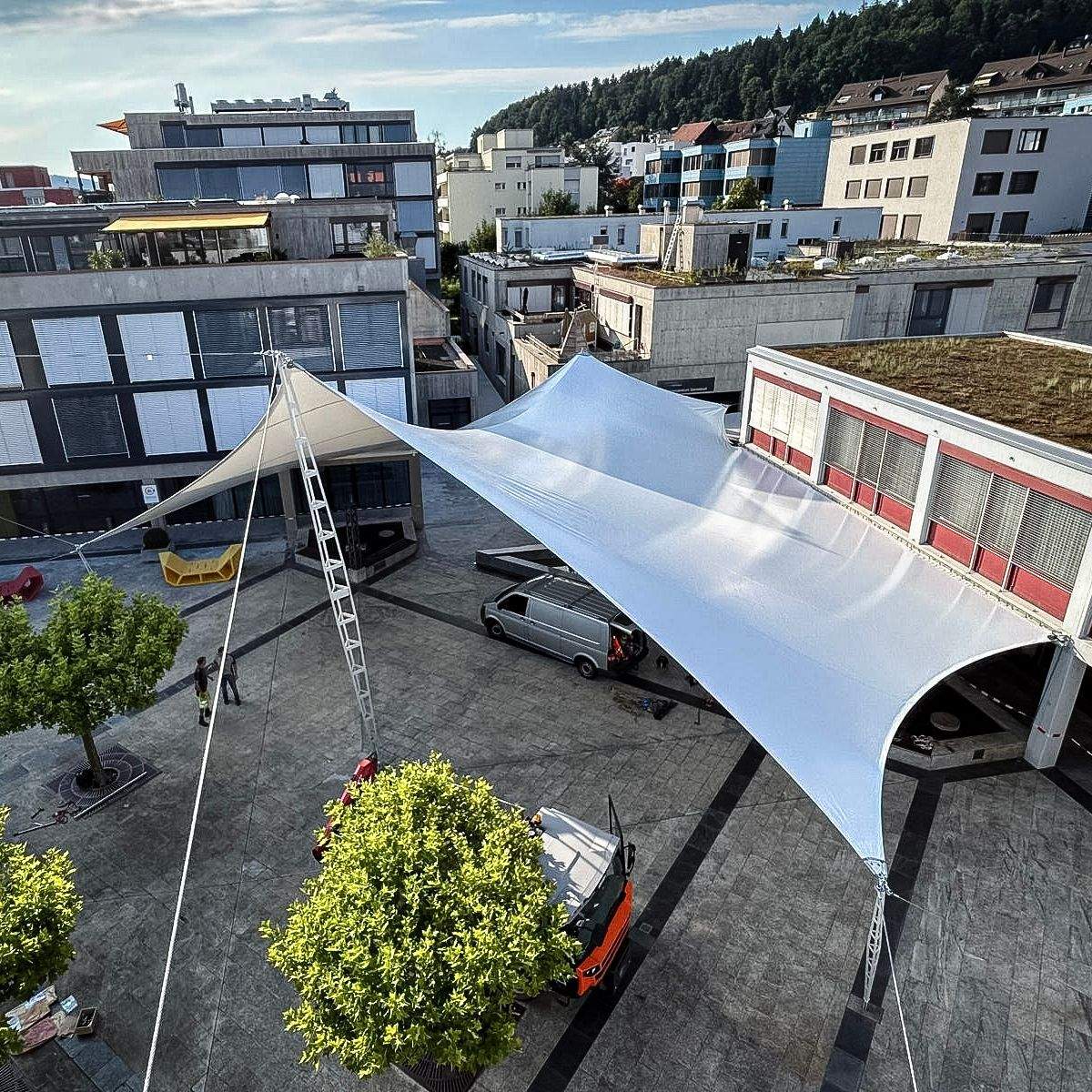
The village square in Geroldswil is a central public space and an important venue for social and cultural events, particularly the annual village festival. In 2007, the square was equipped with a temporary textile canopy specifically developed for this use.
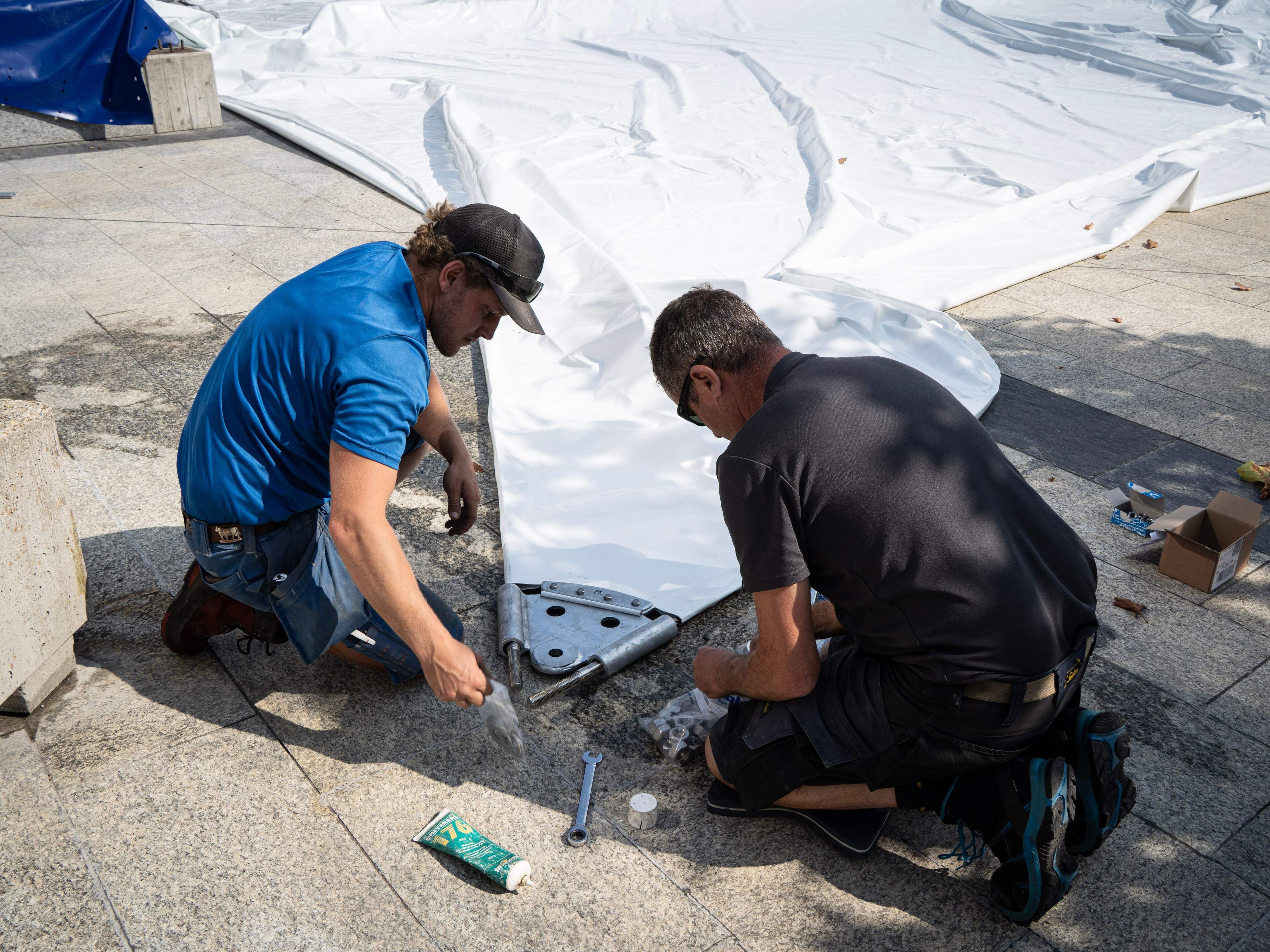
As part of the later redevelopment of the village centre, however, the boundary conditions changed. Some of the original fixing points were lost, the surrounding built context was altered, and no complete structural documentation of the original canopy system was available for the renewal. As a result, the existing structure first had to be reconstructed through reverse engineering, re-evaluated, and adapted to current technical requirements.
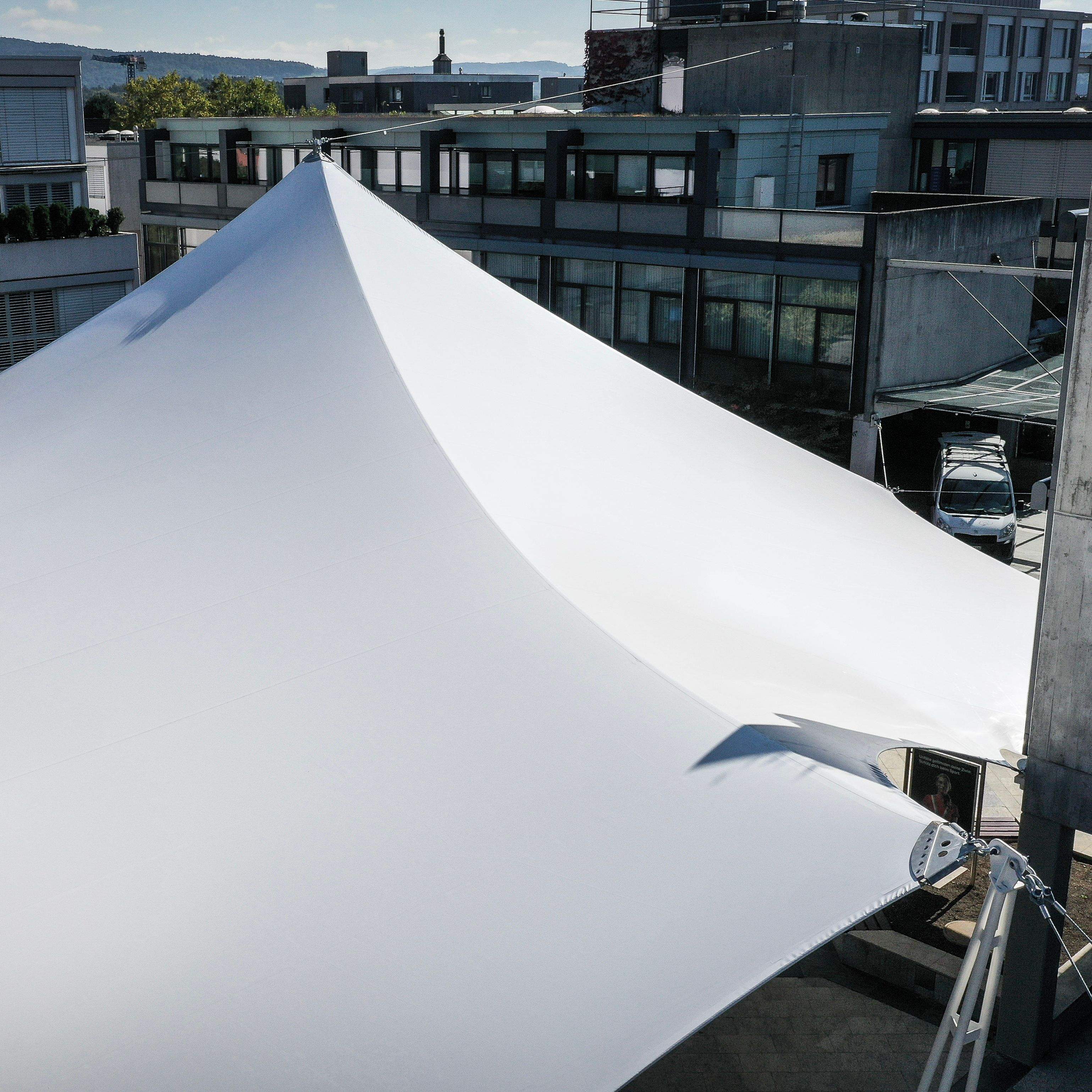
Within that process, attention was drawn not only to the overall structural concept but also to a number of individual construction details. Particularly revealing was the investigation of several corner assemblies, more specifically the corner plates. This article does not address the full optimisation of the canopy, but instead focuses on one selected aspect: the analysis and redesign of four corner details.
Initial Situation: Technically Strong, Yet Highly Demanding
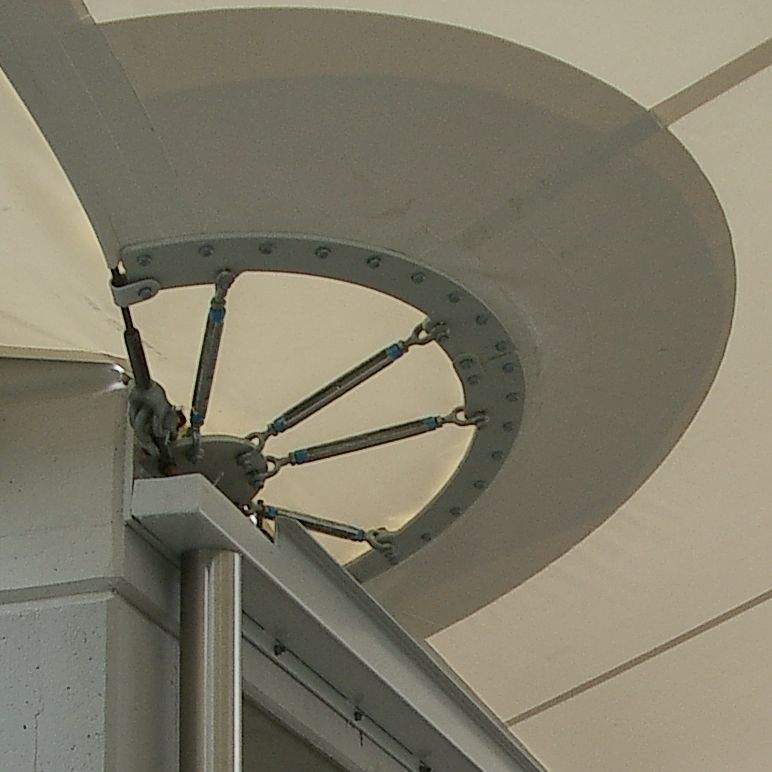
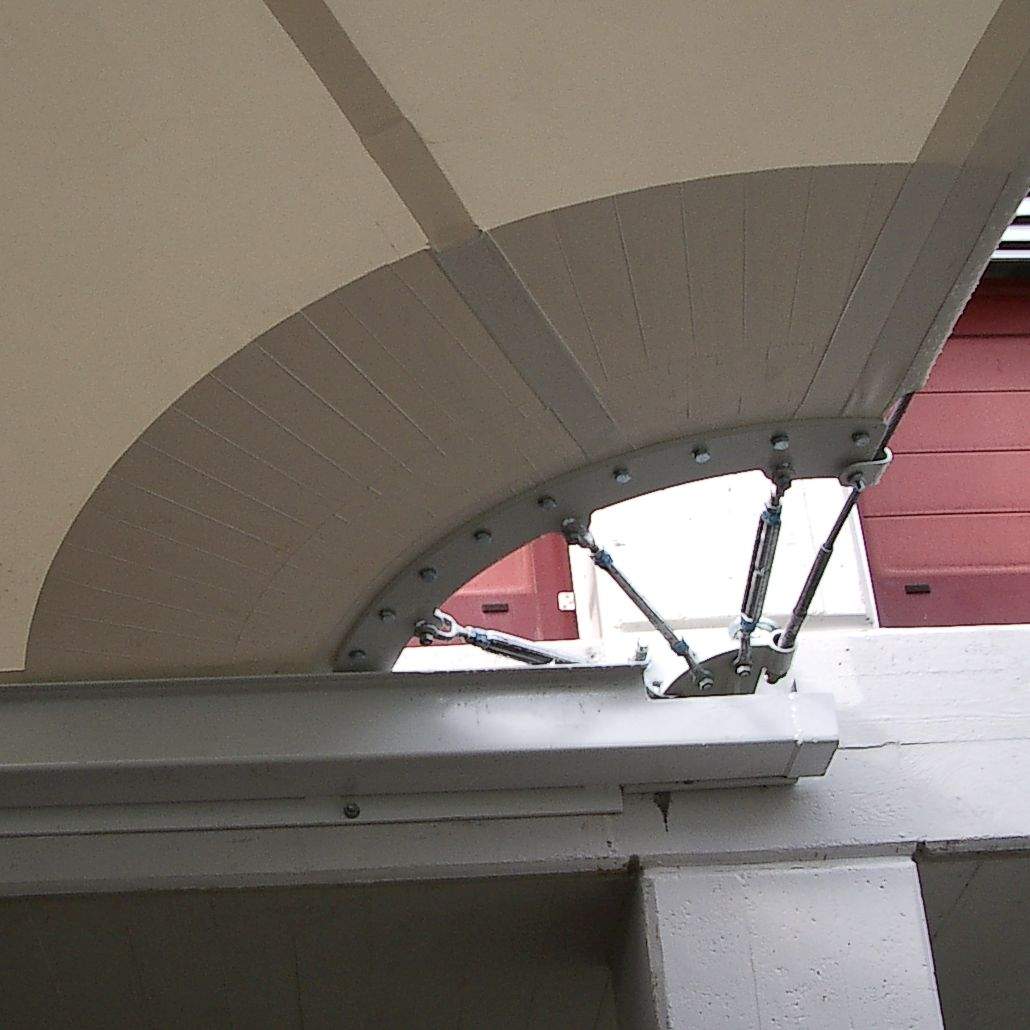
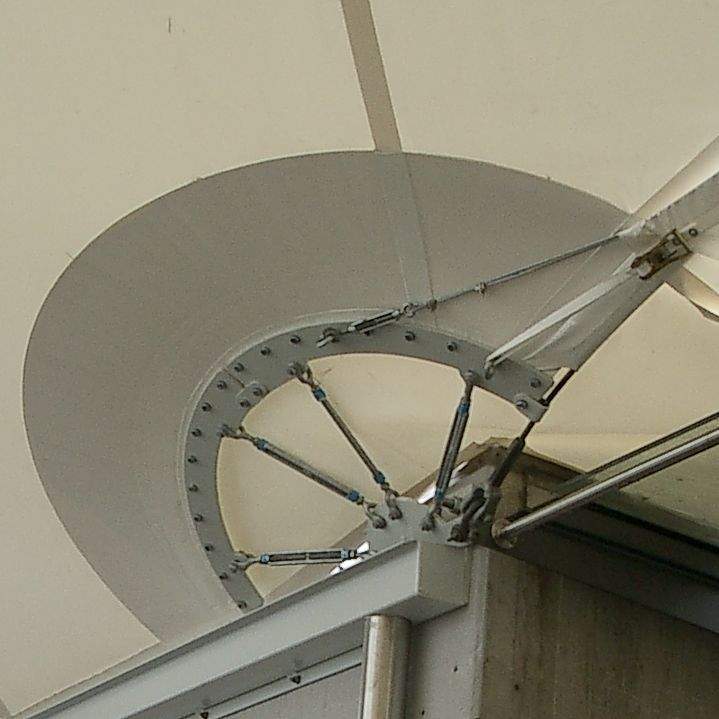
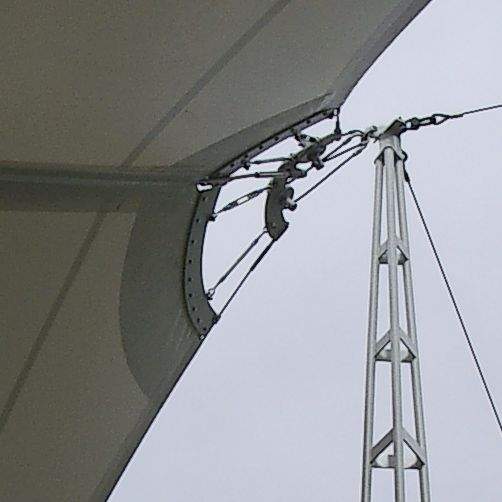
The original corner details were, from a technical point of view, carefully developed and executed to a high standard. They most likely reflected the state of the art at the time they were designed. Their constructive logic followed the principle of transmitting forces along the edge in as continuous a way as possible. Solutions of this level of refinement are otherwise more commonly associated with much larger textile canopy structures.
In that sense, the details were not only functional but also an expression of strong engineering ambition. At the same time, this level of sophistication came with considerable effort. In fabrication, curved keder terminations had to be produced. The assemblies also required numerous individual metal parts, tensioning elements, and bolted connections. On site, the details proved equally demanding: the corner plates were heavy, handling was cumbersome, and the large number of adjustment points increased both installation time and the potential for error.
The Key Question: Replicate or Rethink?
Following the reverse engineering of the existing structure, a fundamental question emerged: should the original detail be reproduced as faithfully as possible, potentially even reusing existing hardware components, or should it be rethought in light of current technical knowledge and methods?
This was not a criticism of the original solution. Rather, it was a logical response to its complexity, the associated effort in fabrication and installation, and the possibilities offered by today’s analytical and digital planning tools. The aim was to understand the original logic, acknowledge its quality, and then assess whether a more robust and efficient solution could be developed under present-day conditions.
Looking Beyond Idealised Models
To evaluate the actual optimisation potential of the corner detail, it had to be analysed far more realistically than is typically the case in strongly idealised modelling approaches. The investigation therefore considered not only the membrane forces in the n_x and n_y directions, but also the shear forces n_xy, the principal stress direction α_m, as well as stress distributions and deformations under different load and boundary conditions.
Only this more detailed level of analysis allowed for a differentiated understanding of the actual structural behaviour in the corner zone. It became possible to distinguish which aspects of the original detailing were genuinely necessary for load transfer and which parts could be reconsidered and simplified without compromising structural reliability.
Finding the Right Conditions for Simplification
Based on years of observation, testing, and gradual exploration of different detailing logics, it is known that under certain conditions simplified corner solutions can be viable. Depending on the specific situation, the role of highly complex hardware assemblies can partly be taken over by suitable membrane reinforcements composed of multiple material layers.
The underlying theory is not discussed in detail here. What matters in this context is that the analysis identified precisely such a condition: a configuration in which a simplified detailing logic proved to be structurally sound, technically appropriate, and justifiable.
The Redesign: Less Complexity, More Efficiency
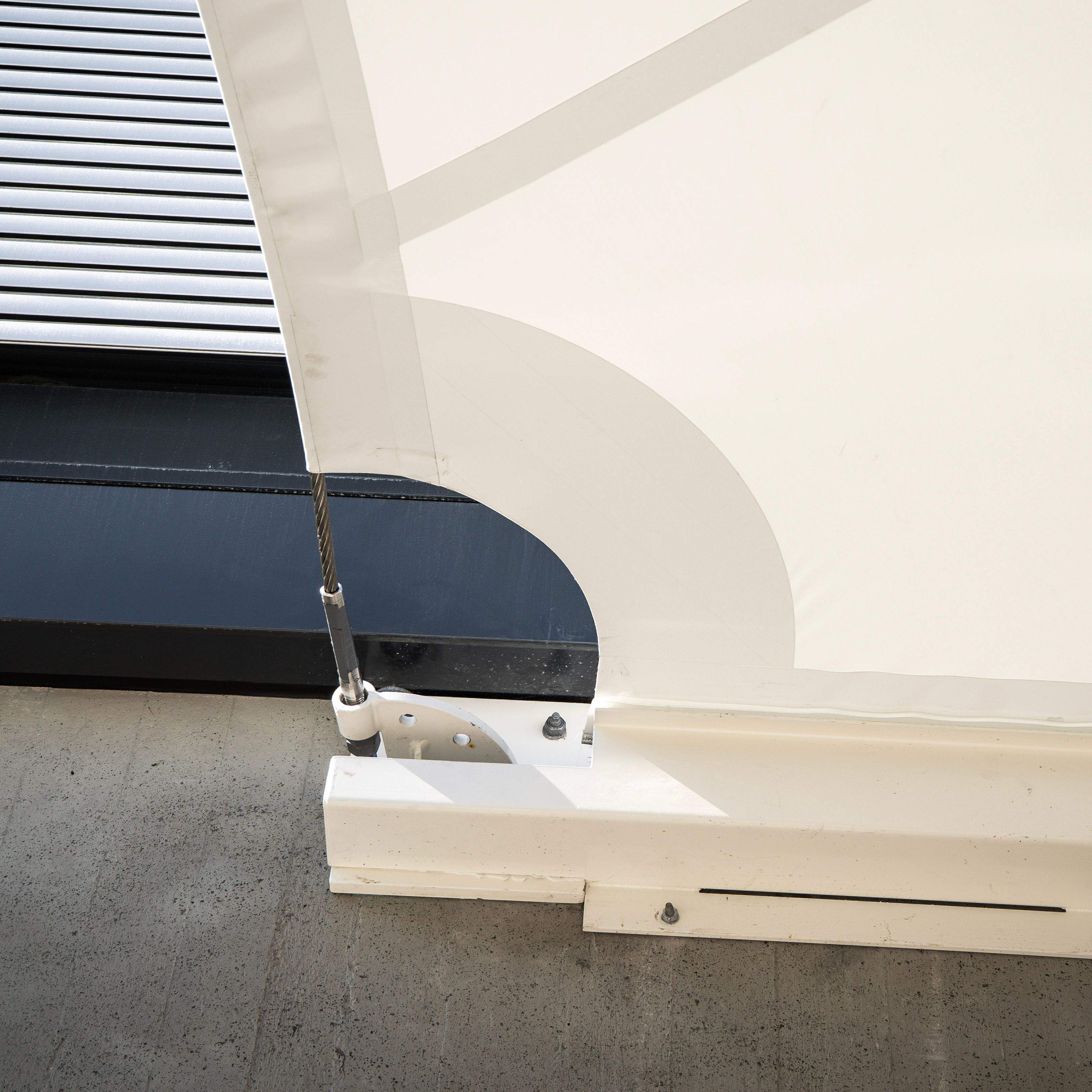
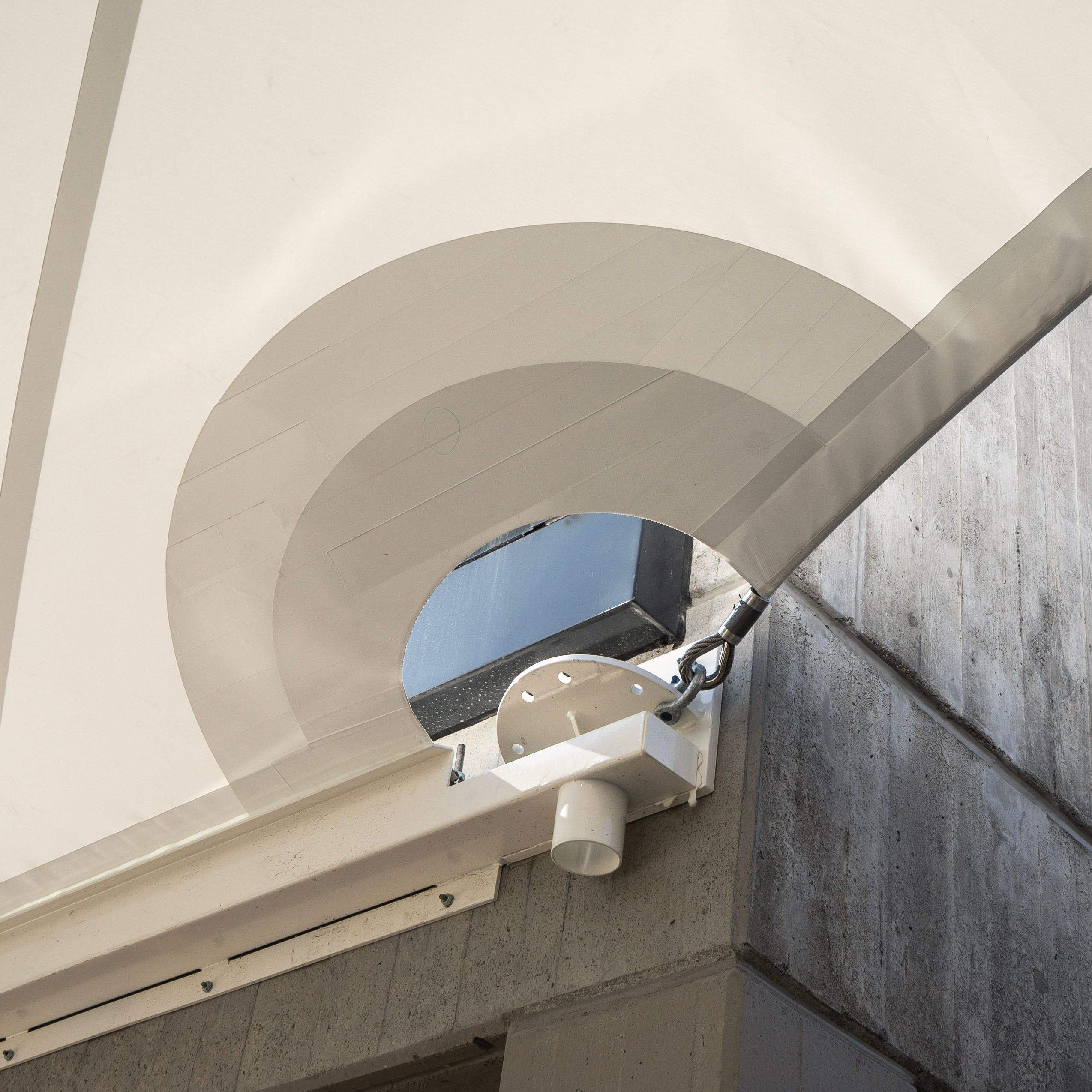
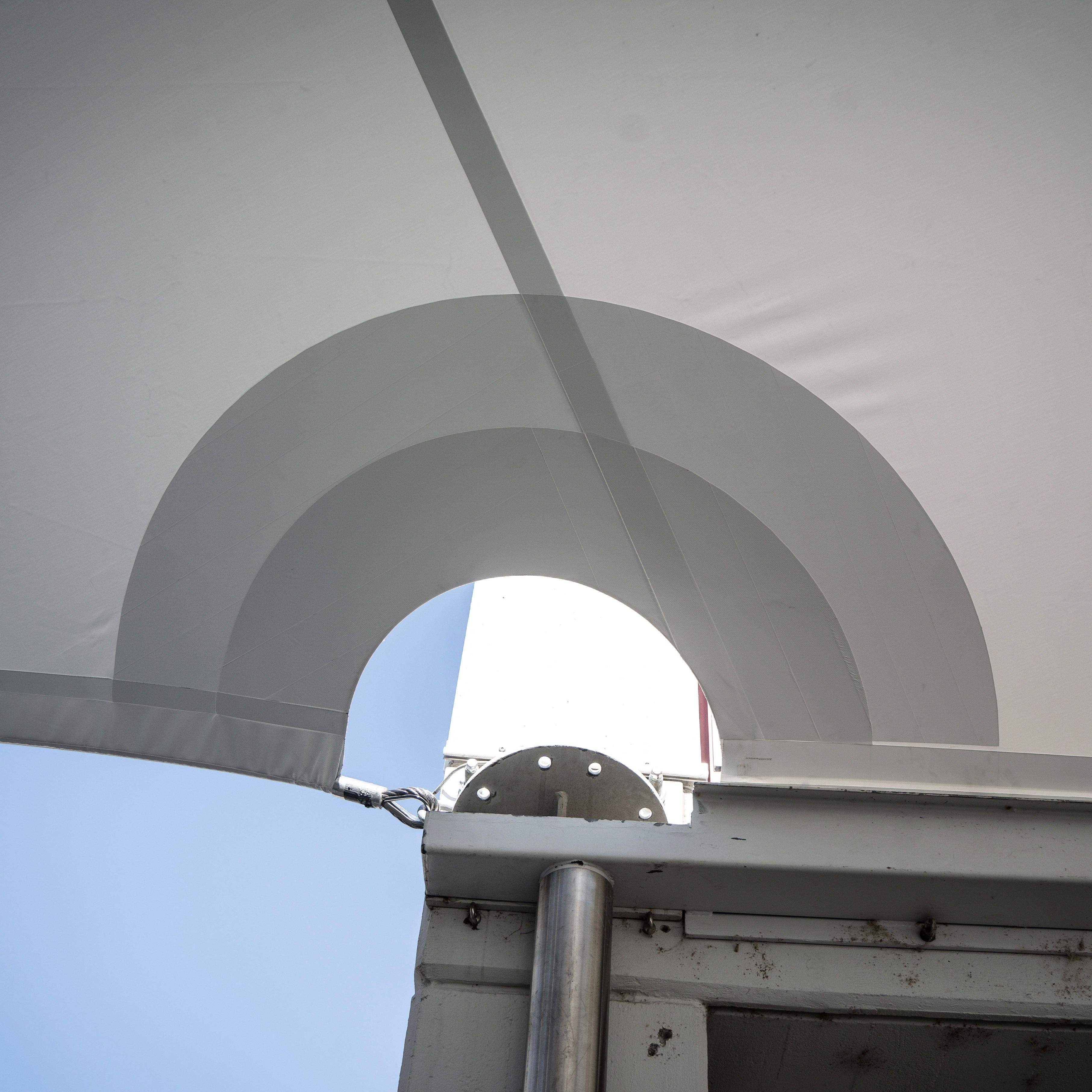
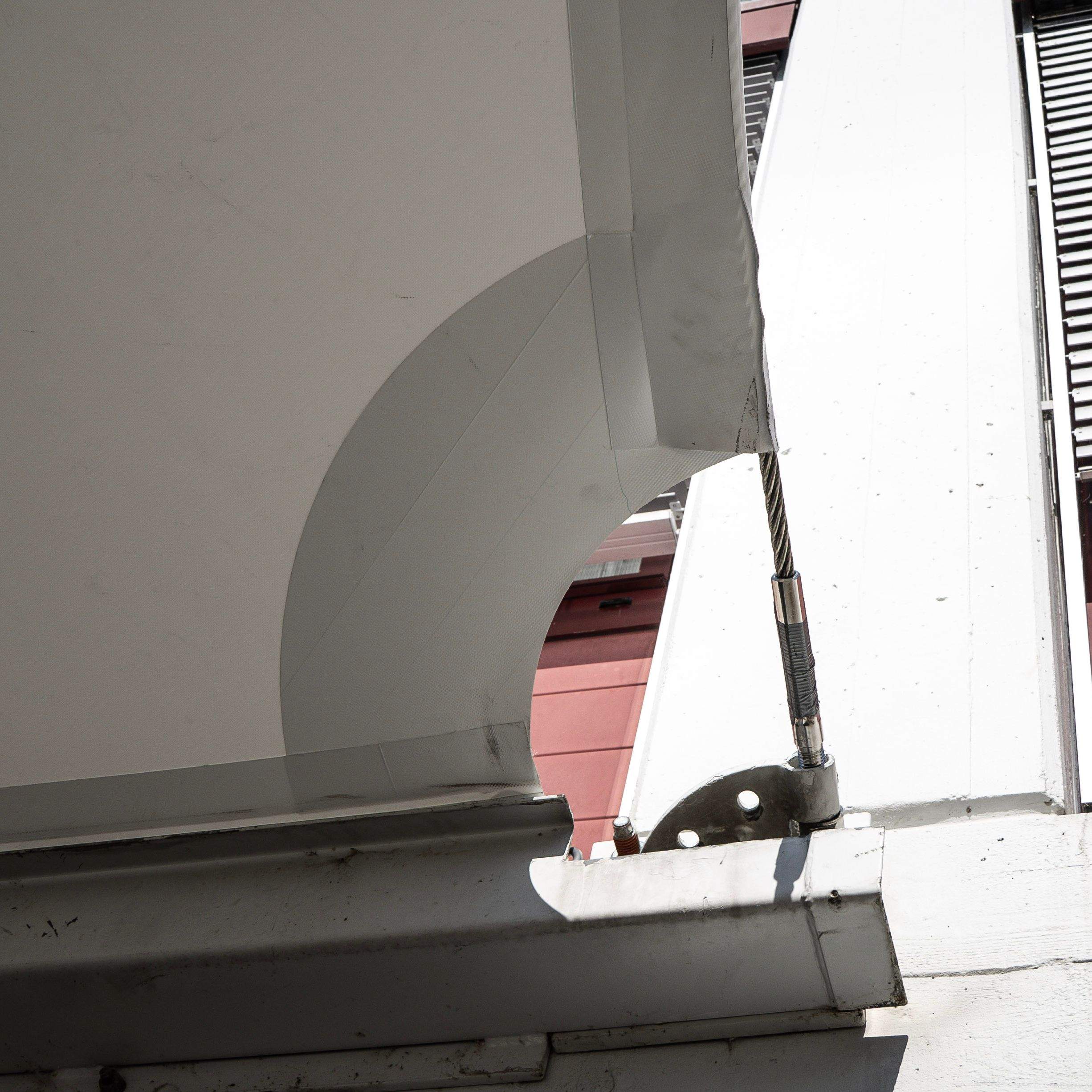
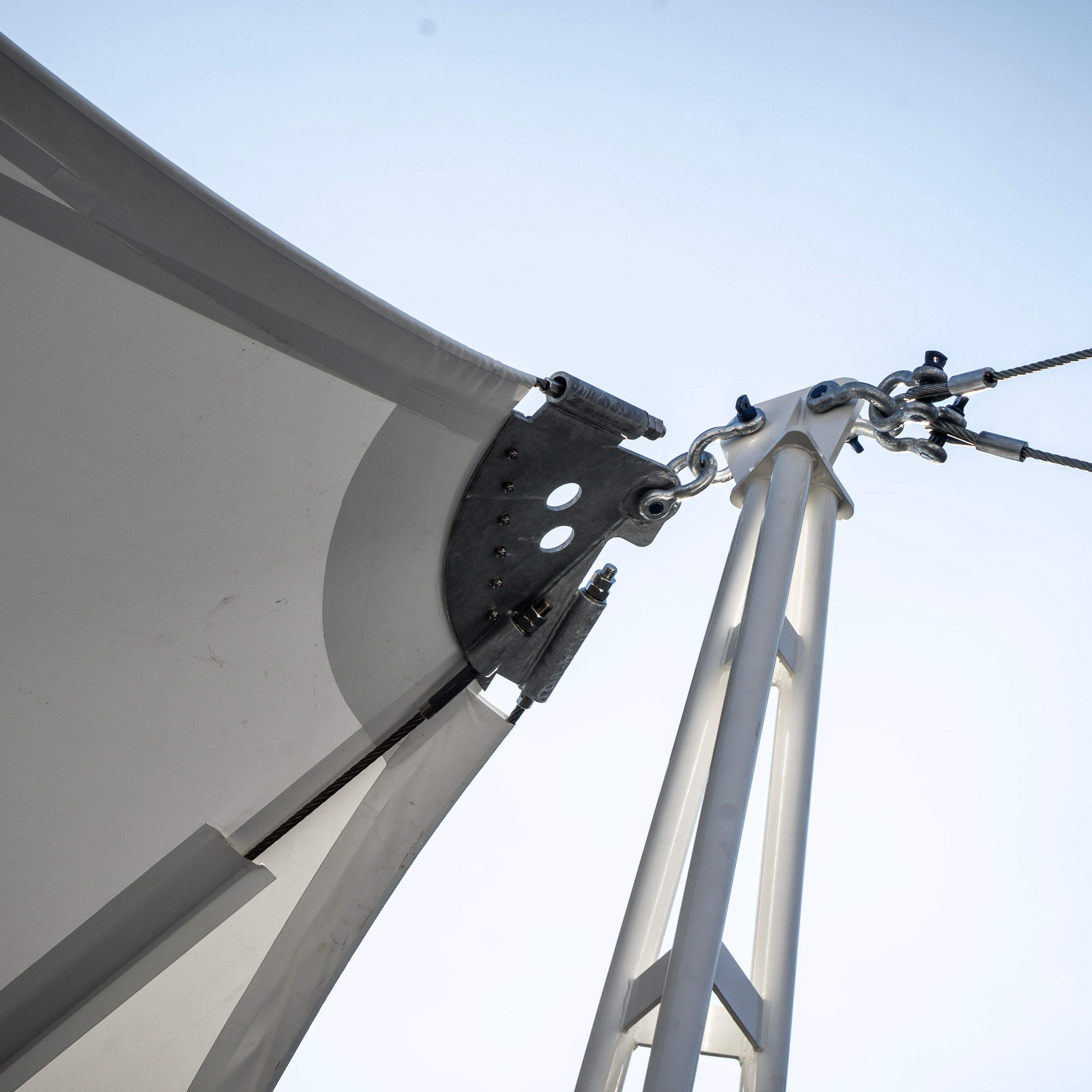
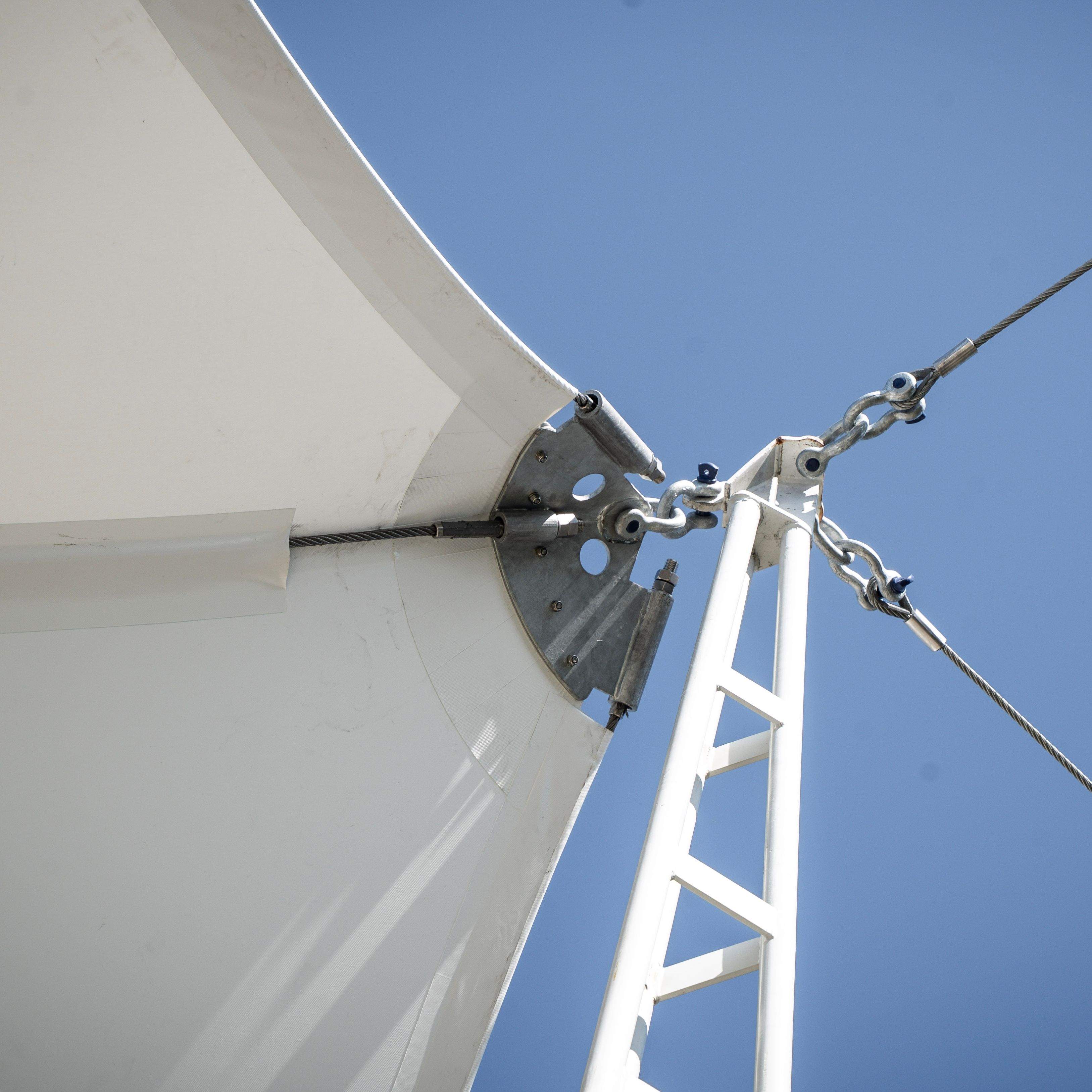
On that basis, four corner details were redesigned. The result was not only a reduction in membrane fabrication effort, but also a simplification of the metal connection itself. Instead of relying on highly specific corner plates, the redesigned solution made it possible to work with a parametrised standard corner plate.
This significantly simplified planning, fabrication, pre-assembly, and installation processes. At the same time, the weight of the components was reduced, while adjustability improved. These advantages became particularly evident during installation and in the context of recurring assembly and disassembly.
Why This Matters Especially for Temporary Structures
For temporary textile structures, this issue is particularly relevant. Unlike permanent construction, effort is not limited to a single moment of completion. Repeated assembly and dismantling are part of the structure’s life cycle. Any constructive simplification therefore affects not only the initial effort, but accumulates over time in fabrication, logistics, handling, and labour input.
In this project, the optimisation of four corner details had a clearly noticeable effect, both on the initial effort and, even more importantly, on recurring operations. This leads to a broader insight: lightweight construction is not only about reducing mass. It is also about reducing material consumption, limiting constructive complexity, and lowering installation and labour effort.
Especially in temporary structures that are assembled and dismantled over many years, this broader understanding is essential. A detail is not truly good merely because it transfers forces elegantly. It becomes truly effective when it also enables appropriate efficiency in fabrication, installation, and operation.
Respecting the Existing as a Basis for Improvement
It is important not to judge the original solution too quickly from today’s perspective. On the contrary, the original corner details deserve considerable respect. They were developed around twenty years ago, at a time when knowledge about textile construction was far less accessible than it is today, and when the analytical and digital tools currently available did not yet exist in comparable form.
Such solutions demonstrate the level of care, engineering understanding, and constructive ambition with which they were developed. That is precisely why existing structures of this kind are so valuable. When they can be accessed through reverse engineering, and when long-term observations of their performance are available, they offer a particularly rich field of learning. They reveal not only how a structure was originally conceived, but also what consequences certain detailing strategies have in practice, in fabrication, installation, and long-term use.
These structures are therefore not just built results, but important case studies.
Conclusion: Making Very Good Solutions Even Better
The work on the corner details in Geroldswil showed, in a very concrete way, that careful analysis and thoughtful interpretation can form the basis for more efficient solutions. It also showed that optimisation does not necessarily mean questioning what already exists. Sometimes it means taking the existing seriously, understanding it precisely, and then developing it further with the means available today.
At its best, the goal is not to replace something good, but to make something very good even better.
All photos are copyright protected by ©Bieri Tenta AG