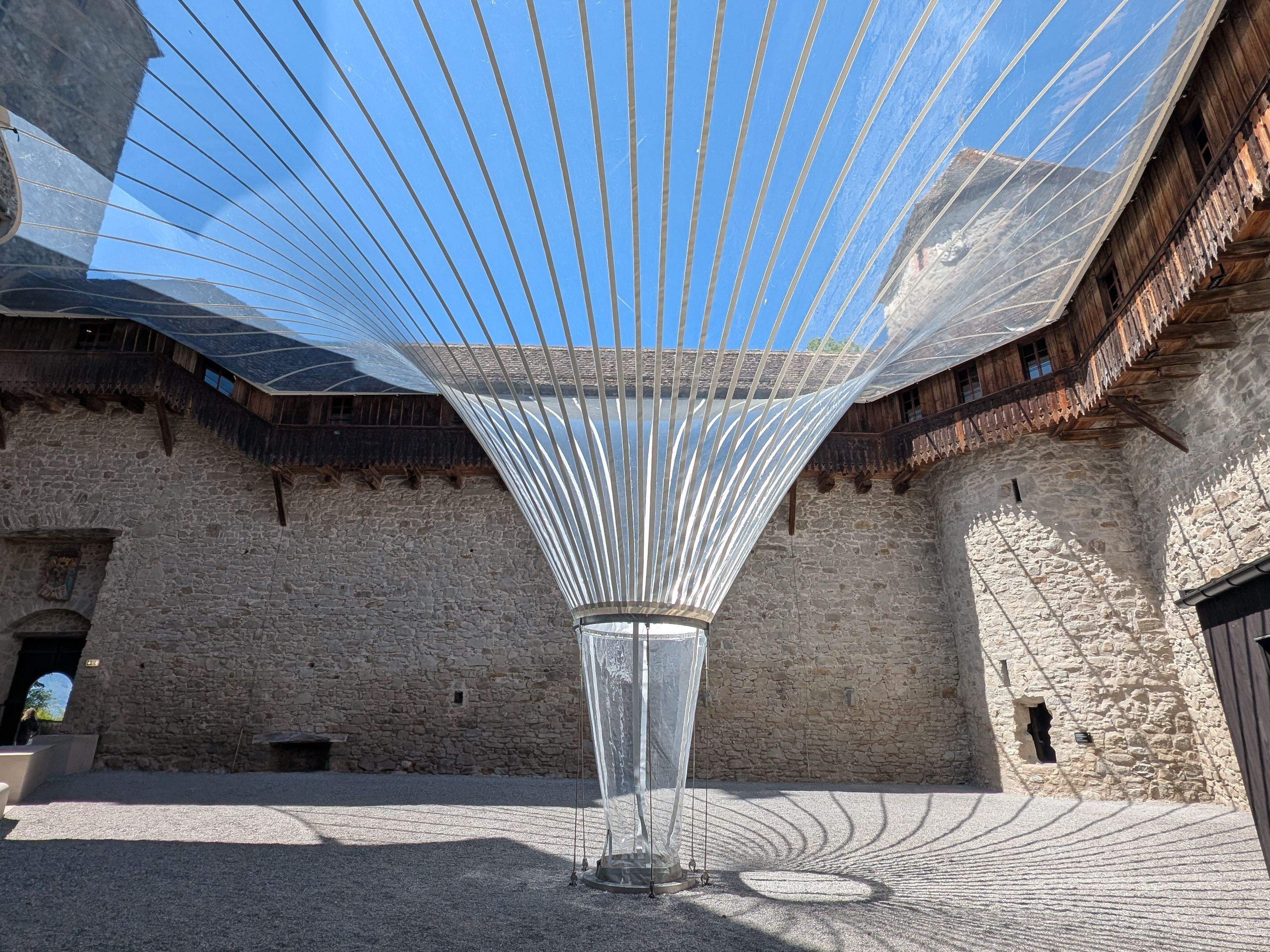
Replacement of the Temporary Funnel-Shaped Roof at Rapperswil Castle
Project overview
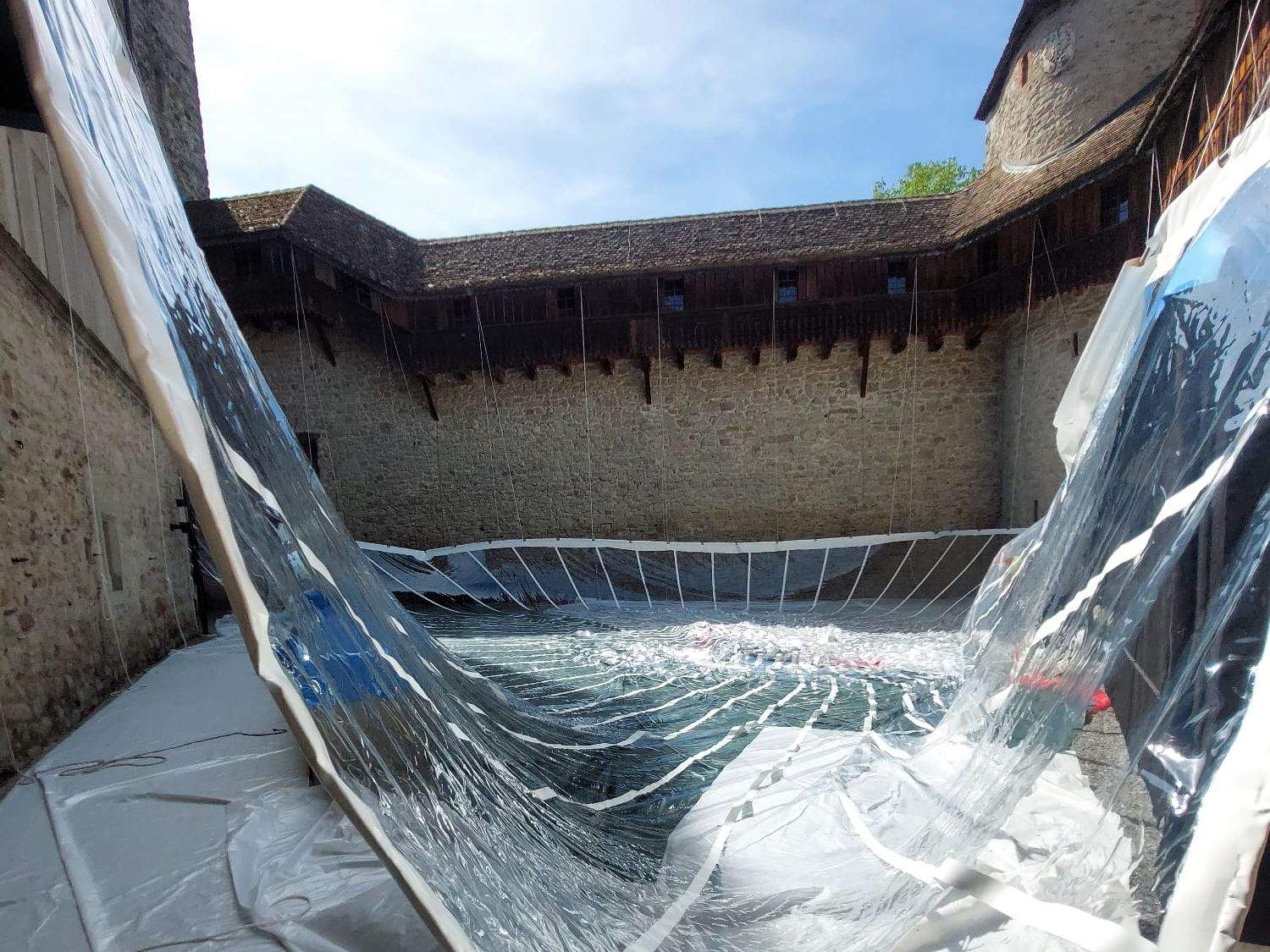
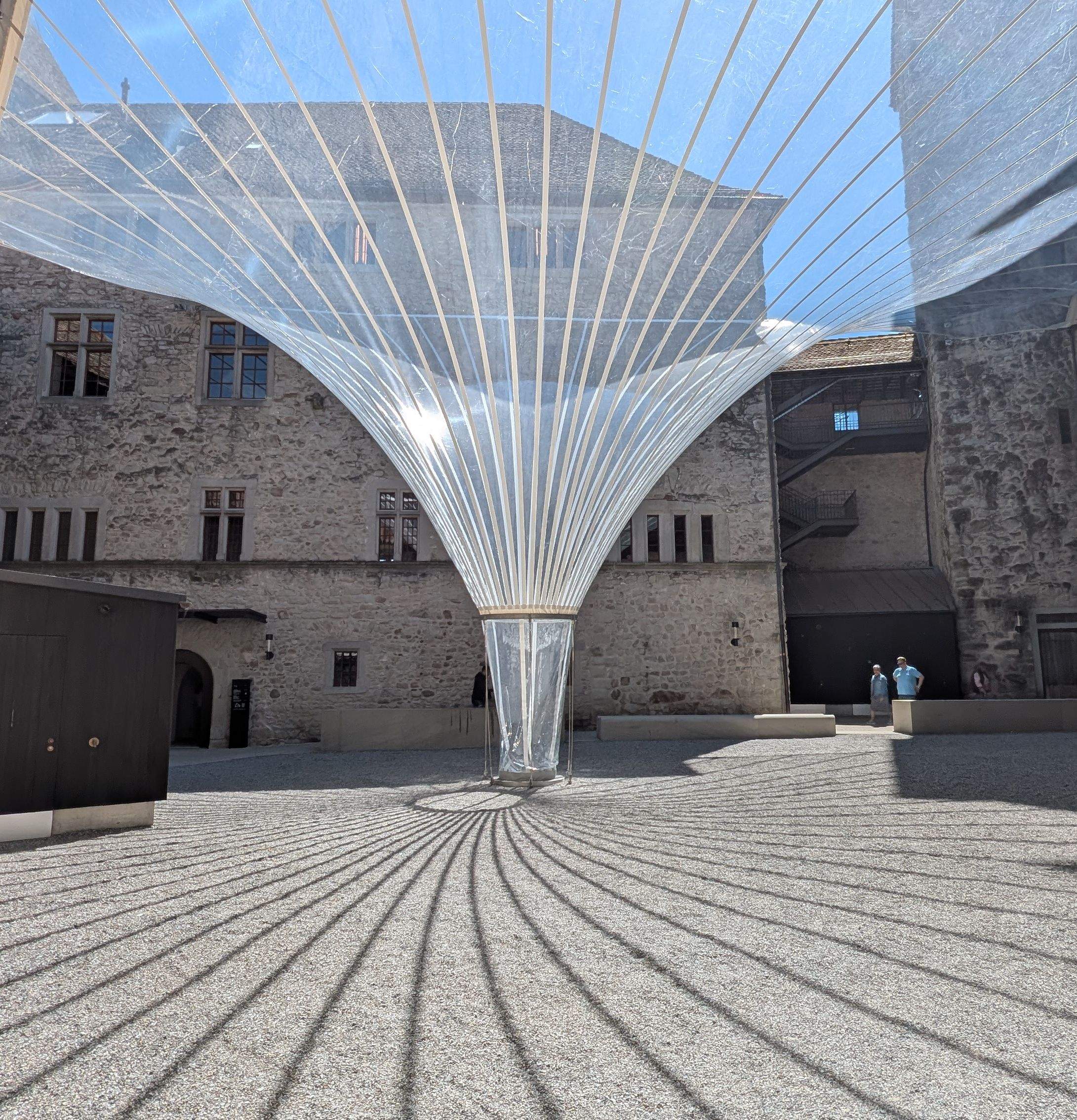
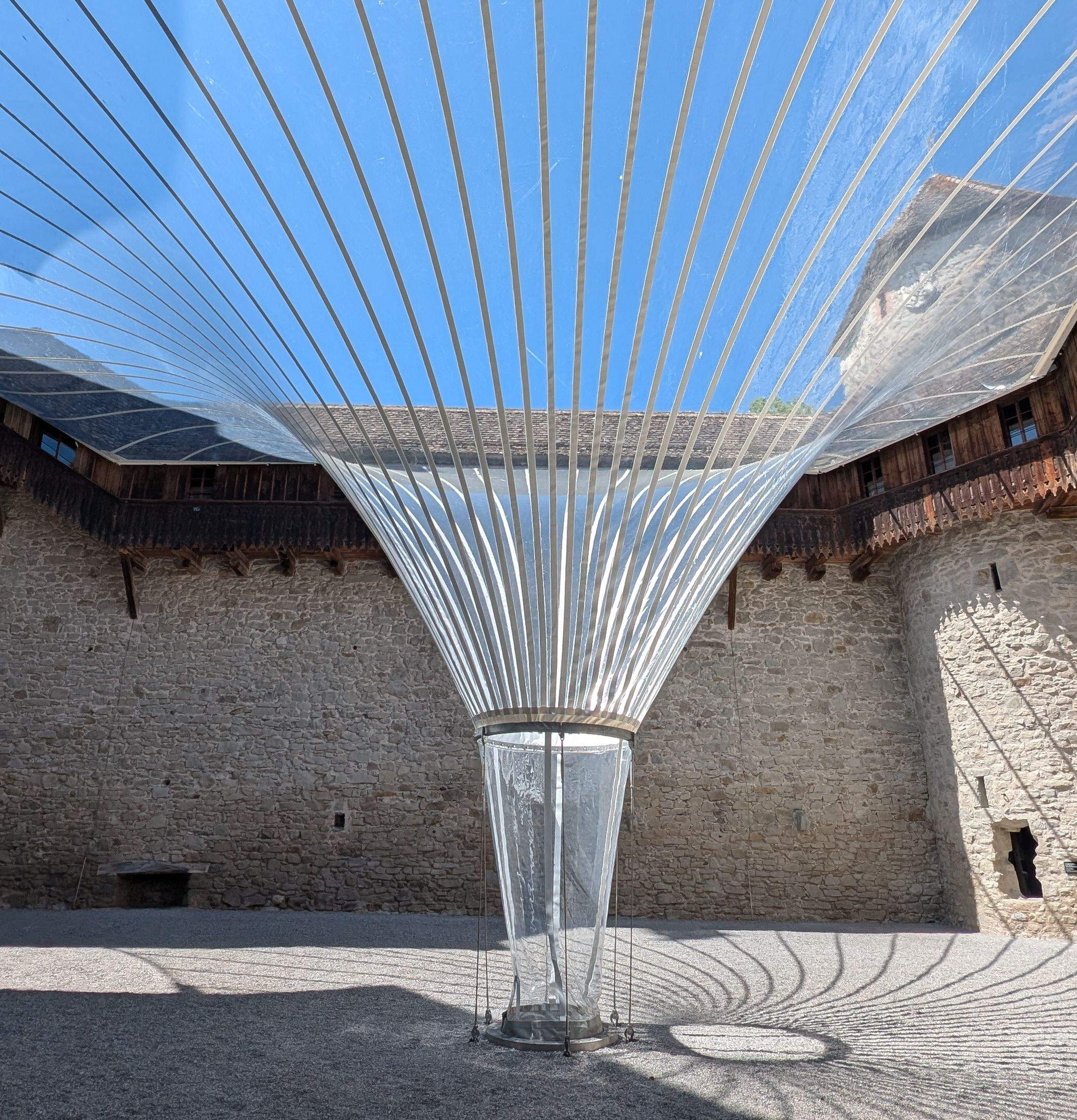
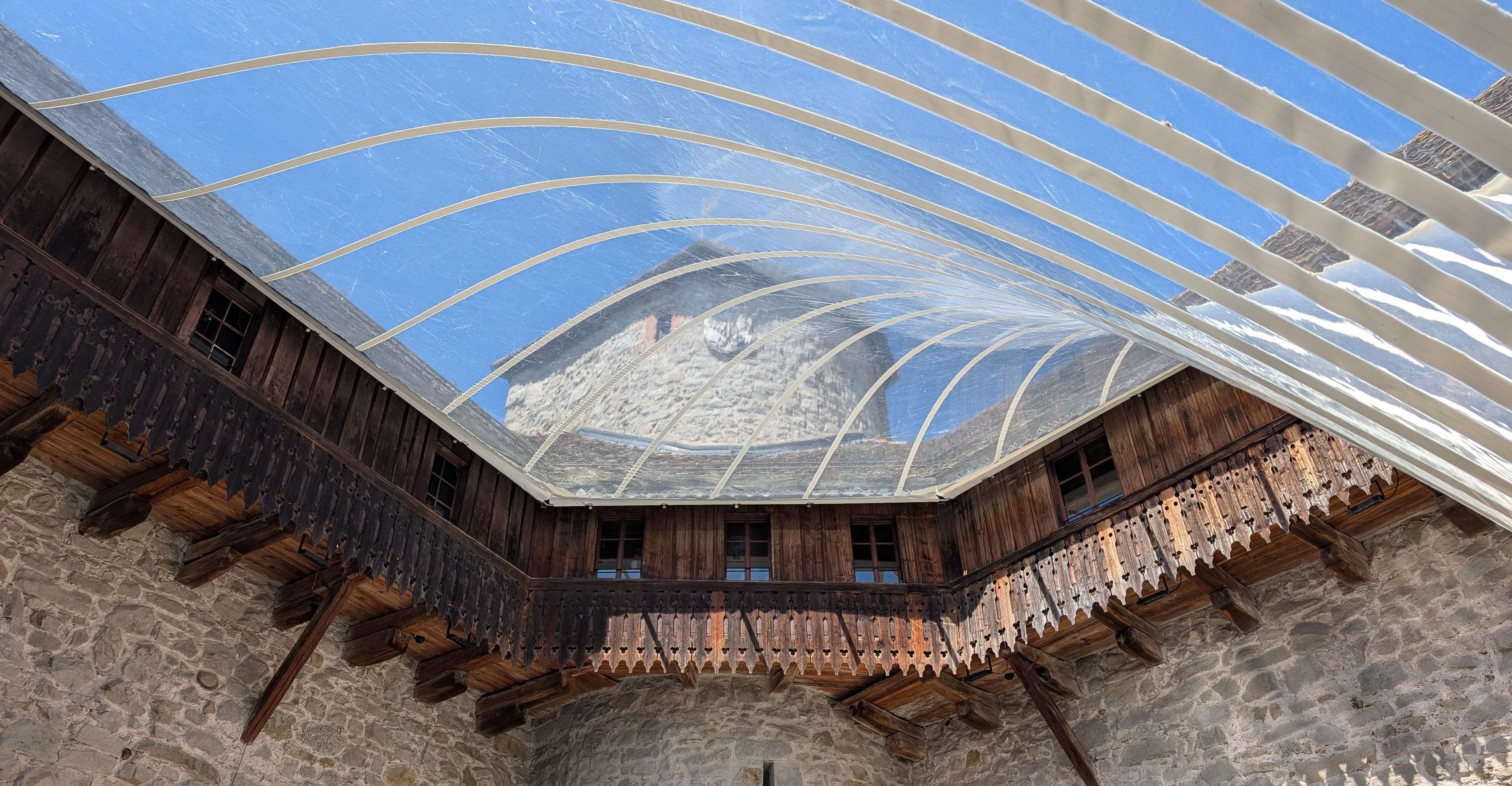
The courtyard of Rapperswil Castle was fitted with a funnel-shaped temporary roof in 2007. Designed as a seasonal membrane structure, it provides weather protection during the warmer months and allows the historic courtyard to be used as a reliable venue for events. In winter, the roof is dismantled and stored.
After nearly two decades of repeated assembly and disassembly, exposure to wind events, and changes to the surrounding built context, the membrane had reached the end of its service life. A replacement became necessary. The challenge was not only to renew the membrane itself, but to do so under altered geometric conditions and without complete and reliable original documentation.
Details
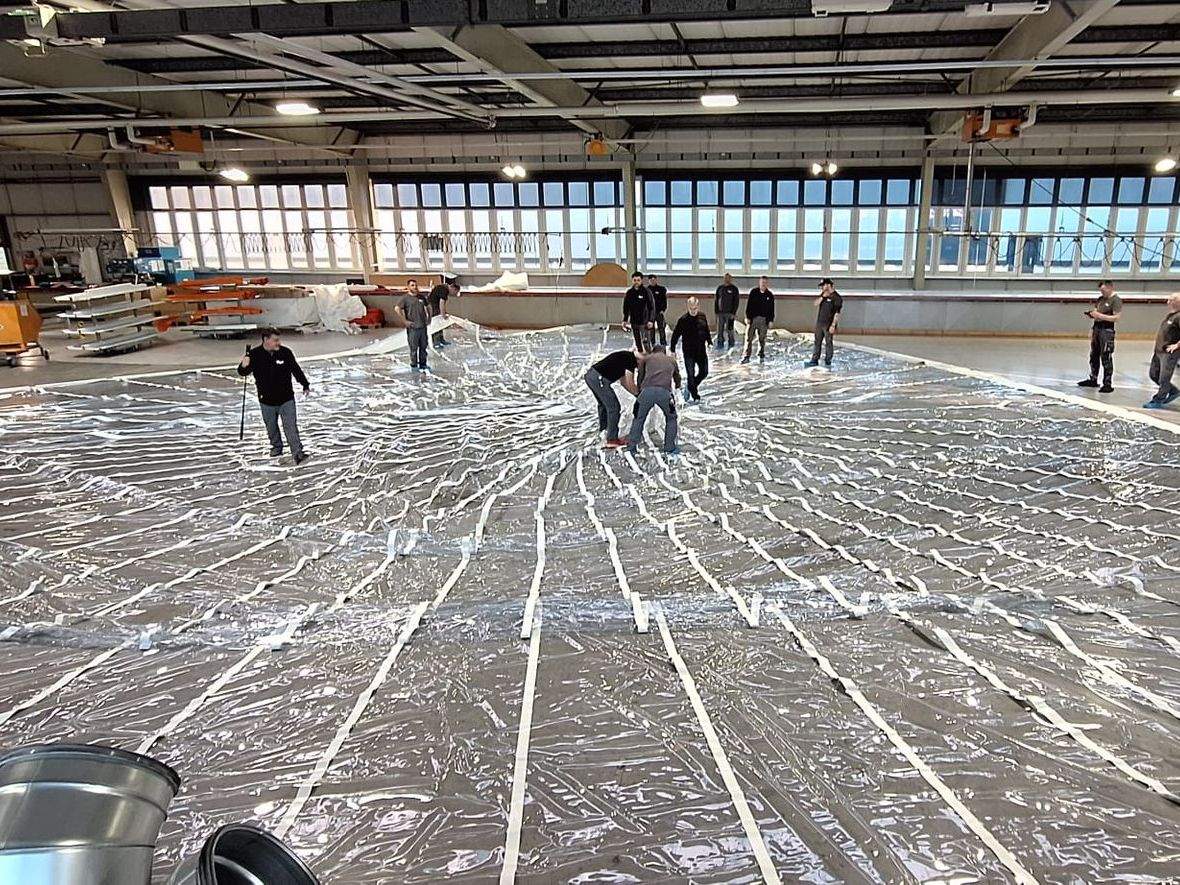
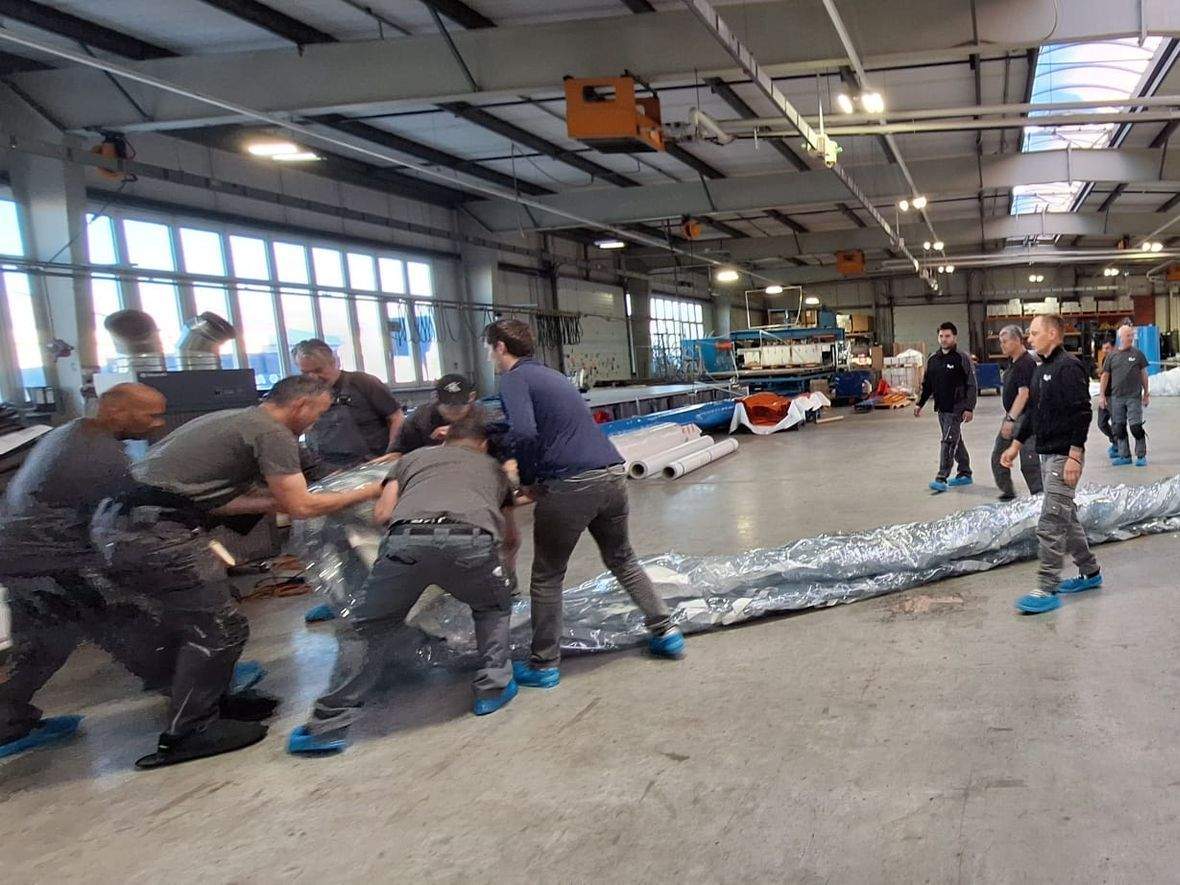
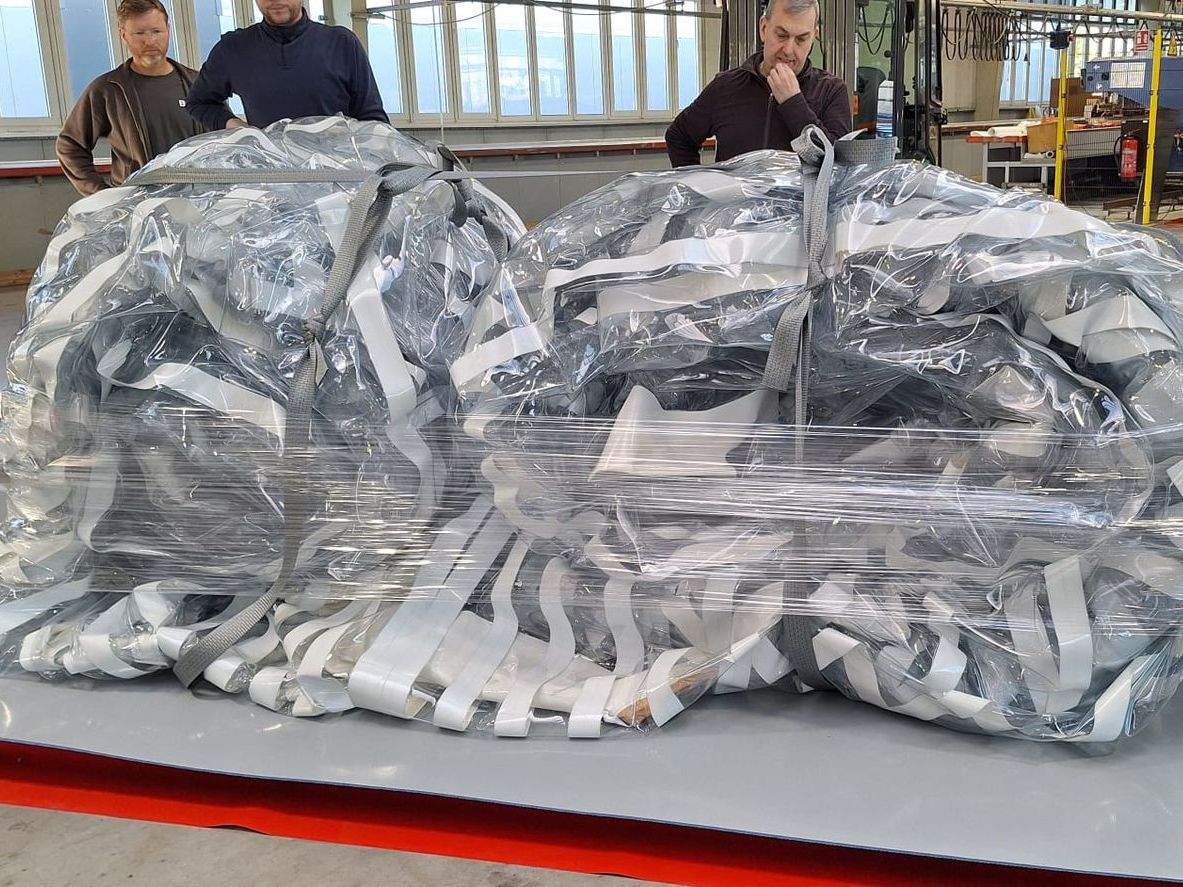
The existing roof is made of clear PVC foil reinforced with PVC-PES webbing straps. It covers a ground plan area of 378 m², while the effective membrane surface reaches 455 m². The structure rises to a height of 12 m and spans approximately 22 × 27 m.
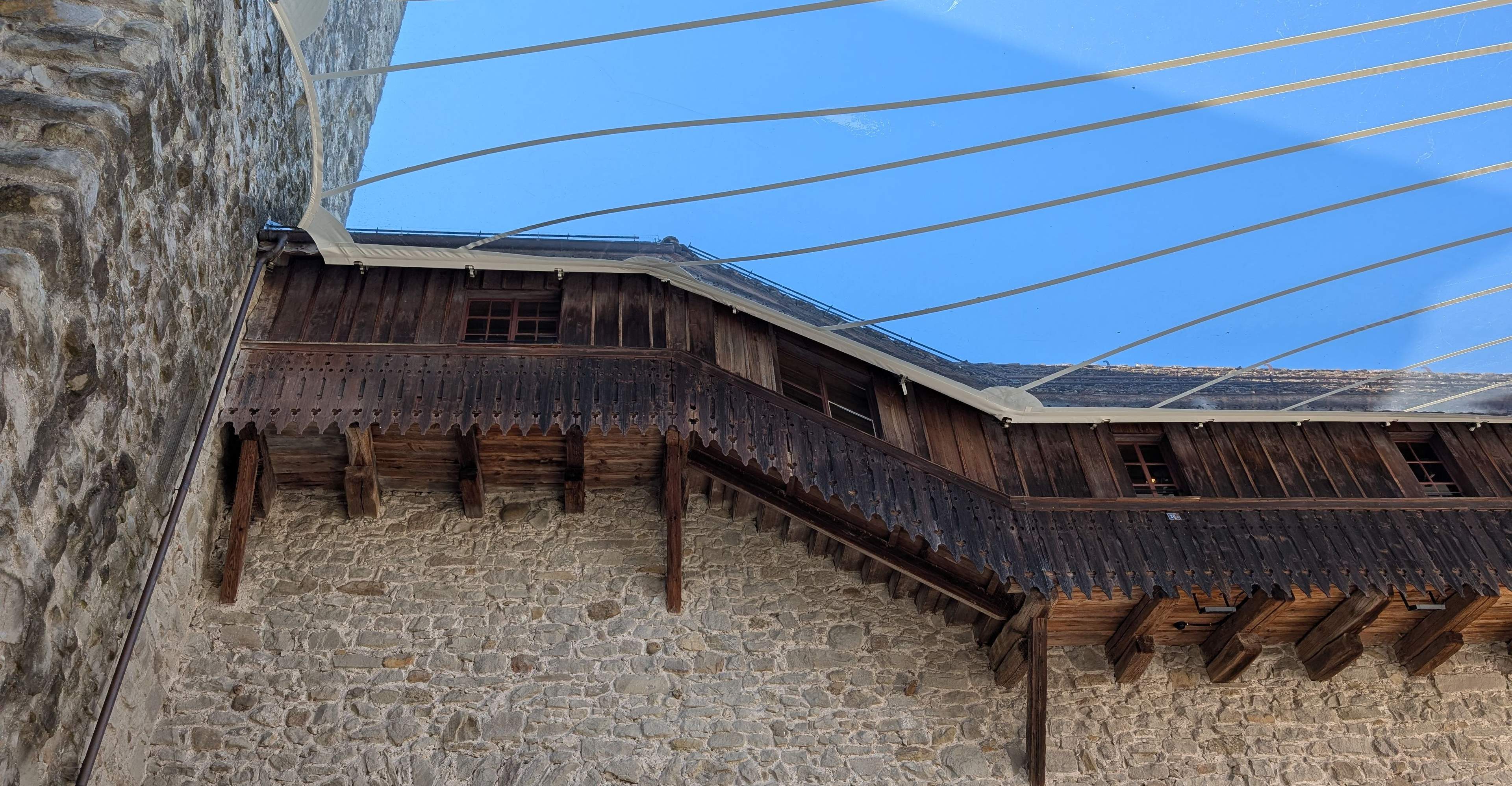
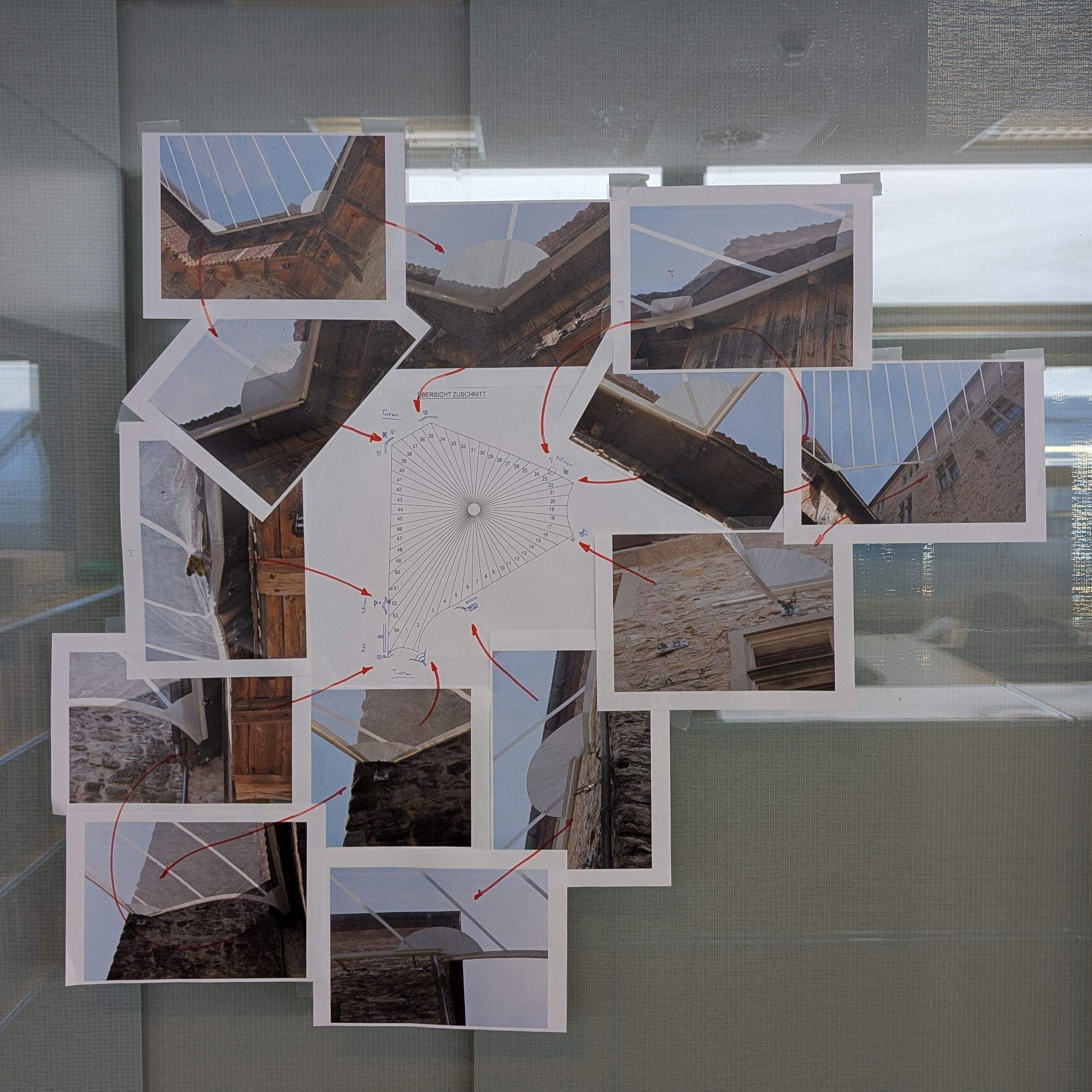
During renovation works in the castle courtyard, the ground-level tensioning ring had to be repositioned. As a result, the original membrane geometry no longer matched the modified site conditions precisely. At the same time, the existing membrane showed clear disturbances in its tension equilibrium, including local distortions, bulging, and wrinkling. Several points of contact with the surrounding building fabric indicated that the built shape had deviated from its intended structural form.
Because no dependable as-built documentation was available, the project began with reverse engineering. A laser scan of the courtyard, carried out by a surveyor during the renovation works, formed the basis for the new planning model. This dataset was supplemented by a small number of surviving drawings and by historical documents obtained through direct contact with the now-retired engineer who had originally designed the roof.
A first form-finding study made it possible to reconstruct the original roof geometry and understand its underlying stress behaviour. At the same time, it became immediately clear that a conventional form-finding process would not produce a viable new membrane under the given constraints. The fixed anchorage points had to be adopted exactly as found, with no possibility of correction or relocation. Under these conditions, the same geometric conflicts that had already caused the existing roof to deform reappeared in the analysis.
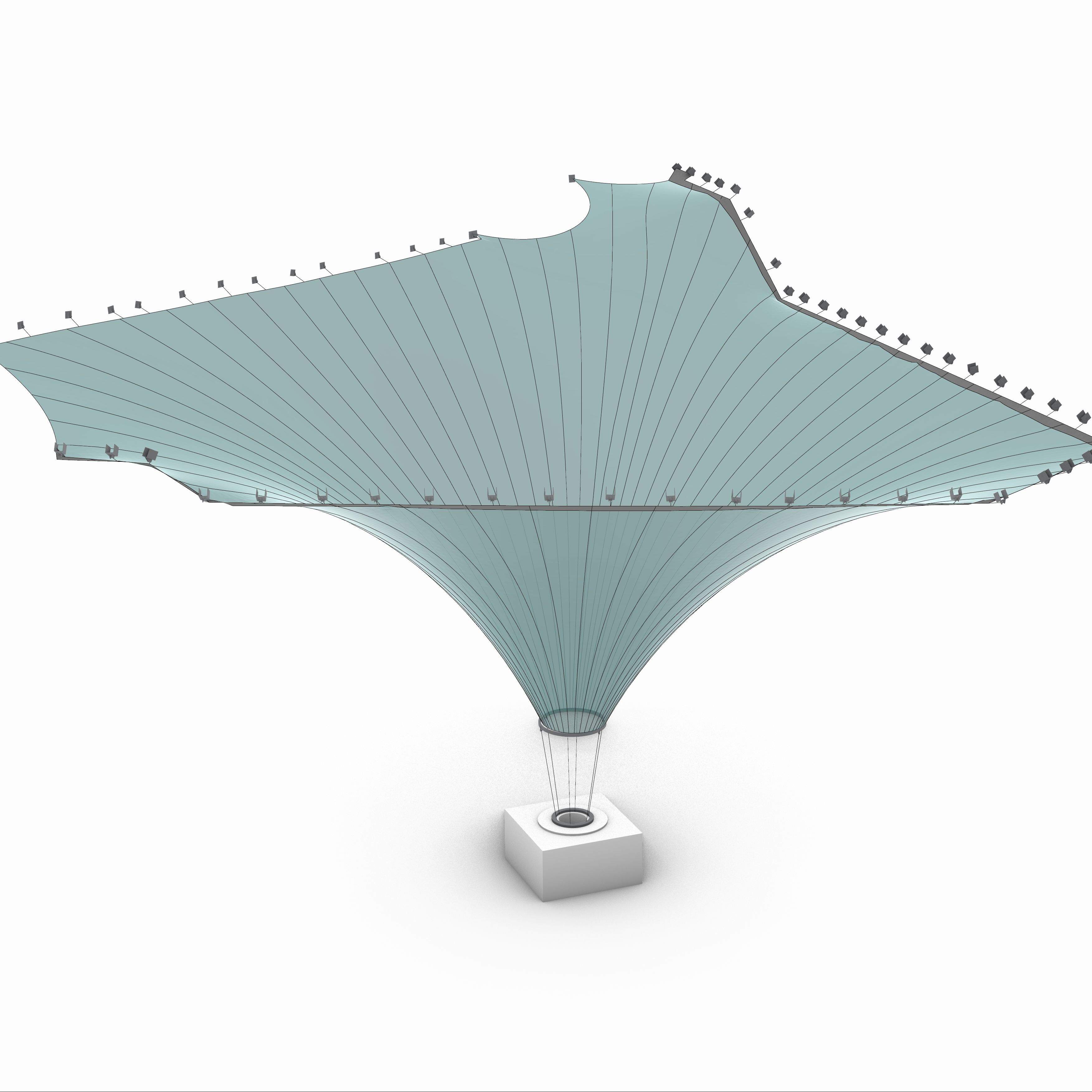
To address this, I developed an unconventional form-finding method in which existing and potential contact zones with the surrounding building were integrated as nonlinear supports. In this way, these direction-influencing constraints became an active part of the form-finding process rather than unresolved aftereffects. The resulting membrane geometry also served as the basis for the structural analysis and dimensioning. This made it possible to reinforce the membrane selectively and to determine the forces transferred into the historic structure with precision, allowing any necessary protective measures to be identified at an early stage.
Specifications
Net roof area | 455 m2 |
Height | 12 m |
Date | 2026 |
Status of the project | Realized |
My sketches
My role
I was responsible for the technical redevelopment of the replacement membrane, from assessment of the existing condition to the generation of a new structurally viable geometry. My work began with the evaluation of the available scan data, the interpretation of incomplete legacy drawings, and the reconstruction of the original roof shape.
Based on this reverse engineering process, I carried out the form-finding and structural analysis for the new membrane. A key part of my contribution was the development of a non-standard modelling approach that incorporated contact zones with the existing building as nonlinear supports in the form-finding process. This allowed the real geometric constraints of the site to be addressed directly rather than idealized away.
The resulting membrane geometry formed the basis for further engineering, including the assessment of stress distribution, the identification of critical zones requiring reinforcement, and the calculation of support forces acting on the existing structure. In this way, the project combined heritage-sensitive adaptation with advanced membrane engineering methods.
Results
The project demonstrates how reverse engineering and structurally informed form-finding can be used to renew a long-serving temporary membrane roof in a sensitive historic setting. Rather than simply reproducing the visible shape of the old roof, the new design responds to the actual built conditions and resolves the geometric conflicts that had caused distortion and loss of prestress in the existing membrane.
The result is a technically grounded replacement strategy for a lightweight seasonal structure that has become an established part of the castle courtyard’s event use.
Note
This project was developed during my time at Bieri Tenta AG. The insights and results presented here are based on my professional experience in the planning and realization of textile architecture as part of my role there.